In the early stages of a software project, automation feels like a superpower. A few lines of YAML can automatically test, build, and deploy code within minutes. However, as teams scale and microservices multiply, this initial simplicity often turns into a maintenance challenge. Many engineering teams—especially fast-growing ones—struggle with what is commonly known as YAML sprawl, where the same CI/CD logic is duplicated across dozens of repositories.
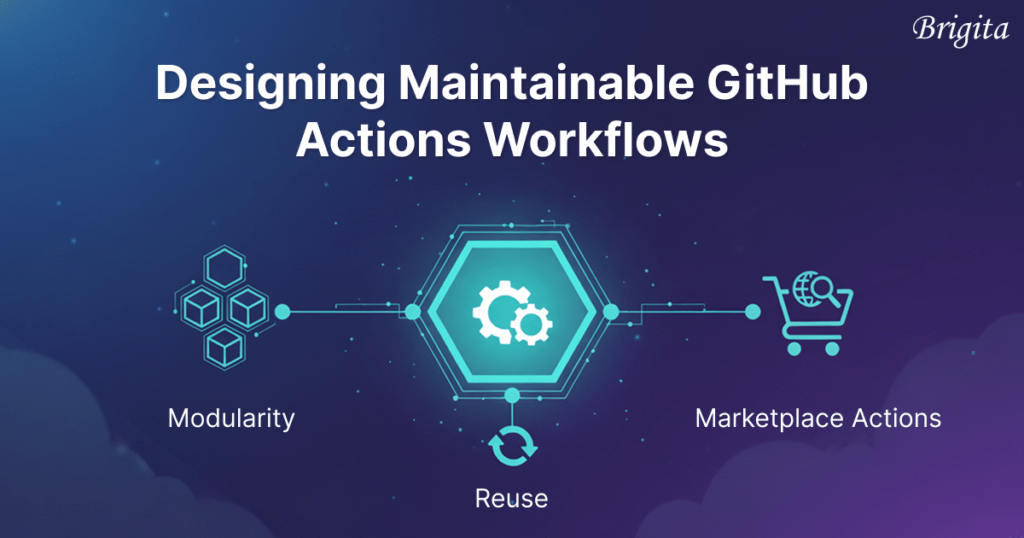
To move from basic automation to enterprise-grade DevOps pipelines, GitHub Actions workflows must be treated as software assets, not disposable scripts. At Brigita, we design CI/CD systems that are modular, reusable, secure, and observable—built to scale with modern cloud-native architectures. This article explores three core pillars of maintainable GitHub Actions workflows: Modularity, Reuse, and Security.
The Power of Reusable Workflows
One of the most common mistakes in CI/CD automation is duplication. When every repository contains its own copy of deployment logic, even small changes—such as adding a new security scan—can become operationally expensive and error-prone.
Reusable Workflows solve this problem by enabling a single source of truth. Instead of defining CI/CD logic repeatedly, teams can centralize workflows in a shared repository and invoke them across projects.
Key Benefits:
Standardization: All teams follow consistent build and deployment patterns.
Centralized Updates: One update automatically applies to every consuming repository.
Reduced Errors: Fewer manual YAML edits mean fewer production issues.
At Brigita, reusable workflows are a foundational element of how we build scalable DevOps platforms for enterprises operating in multi-repository and multi-cloud environments.
Composite Actions vs. Reusable Workflows
A frequent point of confusion is choosing between Composite Actions and Reusable Workflows. While both promote reuse, they serve different purposes.
Composite Actions
Composite Actions are ideal for bundling repeated steps. For example, setting up Node.js, installing dependencies, and configuring caching can be encapsulated into a single action. This reduces noise and improves readability in workflow files.
Reusable Workflows
Reusable workflows operate at a higher level. They allow teams to share entire jobs, including runner definitions, secrets, environment variables, and deployment strategies. These are best suited for standard pipelines such as build-test-deploy or release automation.
By combining both approaches, organizations can create a layered CI/CD architecture that is clean, flexible, and easy to maintain—an approach we consistently apply in Brigita’s cloud and DevOps engagements.
Managing Marketplace Actions with a Security-First Mindset
The GitHub Actions Marketplace accelerates development, but it also introduces supply-chain risk. Using an action without proper controls means trusting third-party code with access to sensitive credentials.
Security Best Practices:
Pin Actions to a Commit SHA: Avoid version tags like @v2. Pinning ensures the exact code you reviewed is what runs in your pipeline.
Internal Mirroring: For regulated industries such as fintech or healthcare, mirroring critical actions into a private organization repository provides full control over updates and audits.
Brigita follows a zero-trust approach to CI/CD security, ensuring that automation pipelines meet enterprise compliance and governance requirements.
Optimizing for Performance and Cost
Efficiency in CI/CD pipelines directly impacts both developer productivity and cloud costs. When pipelines run hundreds of times per day, even small optimizations can result in significant savings.
Performance Optimization Techniques:
Dependency Caching: Using actions/cache can reduce build times by several minutes per run.
Concurrency Controls: Automatically cancel outdated builds when multiple commits are pushed in quick succession.
Matrix Builds: Test multiple runtime versions in parallel without duplicating jobs.
These optimizations are critical for organizations running large-scale CI/CD systems, and they are standard practice in Brigita’s DevOps delivery model.
Governance and Observability
A mature CI/CD platform is not just automated—it is observable and governed.
Best Practices:
Organization-Level Secrets: Centralized secret management reduces risk and simplifies rotation.
Workflow Telemetry: Export workflow metrics using workflow_run events to monitoring platforms such as Grafana or Datadog.
Tracking metrics like build success rate and Mean Time to Recovery (MTTR) provides actionable insights into pipeline health and engineering efficiency.
Conclusion: Future-Proofing Your Automation
Designing maintainable GitHub Actions workflows is an investment that pays long-term dividends. By focusing on modularity, reuse, and security, teams can transform fragile automation scripts into resilient DevOps platforms.
At Brigita, we help enterprises design and operate scalable CI/CD pipelines that align with cloud, DevOps, and platform engineering best practices. Treat your YAML like code, standardize intelligently, and prioritize security—your future engineering teams will thank you.
Frequently Asked Questions
1. How does Brigita use GitHub Actions workflows to enable AI-driven DevOps (AIOps)?
At Brigita, GitHub Actions workflows are designed with observability and telemetry in mind. We export structured pipeline data that can be consumed by AIOps platforms to predict failures, optimize build performance, and reduce Mean Time to Recovery (MTTR) across enterprise DevOps environments.
2. Why are reusable GitHub Actions workflows important for LLM and AI engineering teams?
Brigita works with AI and LLM-driven teams that manage multiple models, environments, and release cycles. Reusable workflows ensure consistent training, testing, and deployment pipelines while minimizing duplication and operational overhead, which is critical for scalable AI delivery.
3. How does Brigita support GEO-distributed engineering teams using GitHub Actions?
Brigita designs standardized CI/CD workflows that work seamlessly for globally distributed teams across regions such as India, the US, and Europe. This ensures consistent security, compliance, and deployment practices regardless of team location.
4. Can Brigita optimize GitHub Actions workflows for AI-assisted development?
Yes. Brigita integrates GitHub Actions with AI-powered code analysis, testing, and security tools. By combining these tools with modular and reusable workflows, we enable AI-assisted DevOps automation that scales with modern cloud-native platforms.
5. Why choose Brigita for GitHub Actions, CI/CD, and DevOps automation?
Brigita combines deep expertise in cloud engineering, DevOps, data, and AI to build secure, scalable, and future-ready CI/CD platforms. Our GitHub Actions workflows are designed with automation, governance, security, and AI-readiness at their core, helping enterprises move faster with confidence.