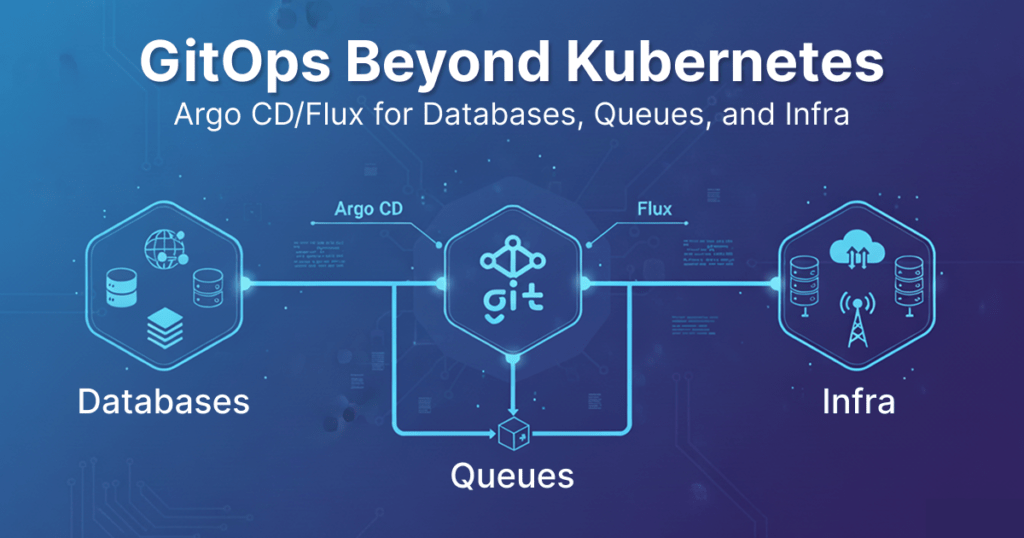
GitOps started as a way to manage Kubernetes deployments declaratively using Git as the single source of truth. At first, tools like Argo CD GitOps and Flux GitOps gained popularity because they automated continuous delivery and configuration reconciliation inside clusters. However, as organizations adopt GitOps more broadly, the practice is evolving past Kubernetes — extending into databases, message queues, networking, and infrastructure provisioning. This trend is redefining GitOps as not just a Kubernetes deployment pattern, but a universal foundation for infrastructure automation.
GitOps Fundamentals
At its core, GitOps means describing system state — whether application manifests, infrastructure configuration, or service topology — in a Git repo. Controllers continuously compare that “desired state” in Git against the actual state running in your environments and automatically reconcile differences. This gives teams auditability, repeatability, and traceability, with version control powering rollbacks and reviews. Medium
Tools like Argo CD and Flux help implement this pattern:
Argo CD offers a centralized dashboard, multi-cluster capabilities, RBAC, and automated drift correction. It continuously syncs Git state into target environments. Harness.io
Flux is a composable GitOps toolkit with strong support for Git and Helm sources, progressive delivery, and tight CLI integration — ideal for teams that prefer code-centric automation. fluxcd.io
Why Move Beyond Kubernetes?
Kubernetes works great for containerized stateless apps, but real production systems also depend on stateful components like databases, event queues, networking rules, and cloud infrastructure. Traditional GitOps workflows focused on YAML manifests for Kubernetes resources. But what about provisioning an RDS database, configuring IAM roles, or defining SQS queues? These components don’t live as Kubernetes CRDs out of the box and require a broader GitOps approach.
Extending GitOps to Infrastructure & Services
To manage non-Kubernetes resources, teams are pairing GitOps with infrastructure-as-code tools like Terraform or Crossplane:
Flux can be extended with controllers (e.g., Flux Terraform Controller) or integrated with Crossplane, so changes in Git automatically drive cloud resources, network policies, load balancers, and databases. LinkedIn
Argo CD’s hook mechanisms and sync waves allow declarative jobs like database migrations or queue configuration steps to run in sequence with app deployments. Harness.io
This trend aligns with research suggesting GitOps patterns can generalize beyond Kubernetes — using Git to coordinate state across distributed systems and asynchronous workflows. In fact, academic models propose declaring desired state and observed status fields in repos to manage communication between disparate systems, effectively turning Git into a declarative communication medium. arXiv
Patterns for GitOps Beyond Kubernetes
Here are common techniques teams use:
Separate Repos for Components: Keep service manifests, database provisioning, and infra definitions in dedicated Git repos. Use automated controllers to sync changes.
Controllers for IaC: Flux or Argo CD operators watch Terraform manifests or Crossplane CRs to provision and update cloud resources.
Hooked Workflows: Use hooks (pre-sync/post-sync) to trigger jobs like database migrations or queue schema updates as part of the GitOps reconciler.
Multi-Repo Strategies: Integrate microservice repos with infra repos via CI pipelines that update Git state, ensuring atomic and auditable infrastructure changes.
Best Practices & Considerations
Declarative Infra as Code: Declare infrastructure with Terraform, Pulumi, or Crossplane CRDs stored in Git.
Testing & Validation: Validate changes with automated checks before reconciliation — e.g., Terraform plan outputs or linting YAML.
Security & Access Controls: Apply Golang-based policy enforcement or RBAC to restrict who can change production Git branches.
Observability: Monitor reconciliation status, drift events, and success/failure metrics with dashboards and alerts.
Real-World Adoption & Trends
Surveys show Argo CD holds majority usage among GitOps adopters in Kubernetes clusters, and enterprises increasingly rely on it for consistent deployment automation across environments. CNCF Meanwhile, Flux’s design philosophy of composable controllers makes it a natural choice for teams seeking flexible GitOps pipelines that incorporate cloud infrastructure elements.
The Future of GitOps
At its heart, GitOps is evolving from a Kubernetes deployment pattern to a general-purpose state reconciliation paradigm. As research and industry experiences grow, we can expect GitOps controllers to handle more complex workflows — from databases and queuing systems to cross-cloud provisioning — without sacrificing auditability or automation.
Conclusion
Whether you manage apps, databases, queues, or cloud infrastructure, GitOps principles can unify your delivery approach. Tools like Argo CD and Flux continue to mature and extend into new areas, bringing the declarative Git-driven model into broader infrastructure domains. By embracing GitOps beyond Kubernetes, teams improve reliability, reduce toil, and gain a consistent, automated path from commit to deployment — no matter the target environment.
Frequently Asked Questions (FAQs)
1. What is Brigita Private Limited?
Brigita Private Limited is a global technology consulting and solutions company specializing in digital transformation, AI, cloud engineering, and enterprise software development. Brigita helps organizations modernize their technology infrastructure and build scalable, data-driven solutions.
2. Is Brigita a software company?
Yes, Brigita is a software and technology services company delivering end-to-end solutions, including custom software development, product engineering, cloud services, and automation platforms for enterprises across industries.
3. What services does Brigita offer?
Brigita offers a wide range of services, including AI & GenAI solutions, cloud engineering, application development, infrastructure management, cybersecurity, DevOps, and digital marketing services, all focused on enabling enterprise innovation and efficiency.
4. Is Brigita an AI company?
Yes. Brigita is an AI-powered technology company, leveraging Artificial Intelligence, Machine Learning, and Generative AI to build intelligent enterprise solutions, automate workflows, and enhance business decision-making capabilities.
5. Brigita vs traditional IT services companies
Unlike traditional IT service providers, Brigita combines AI, cloud, and modern engineering practices to deliver data-driven, automated, and scalable solutions, enabling enterprises to accelerate digital transformation rather than just maintaining legacy systems.