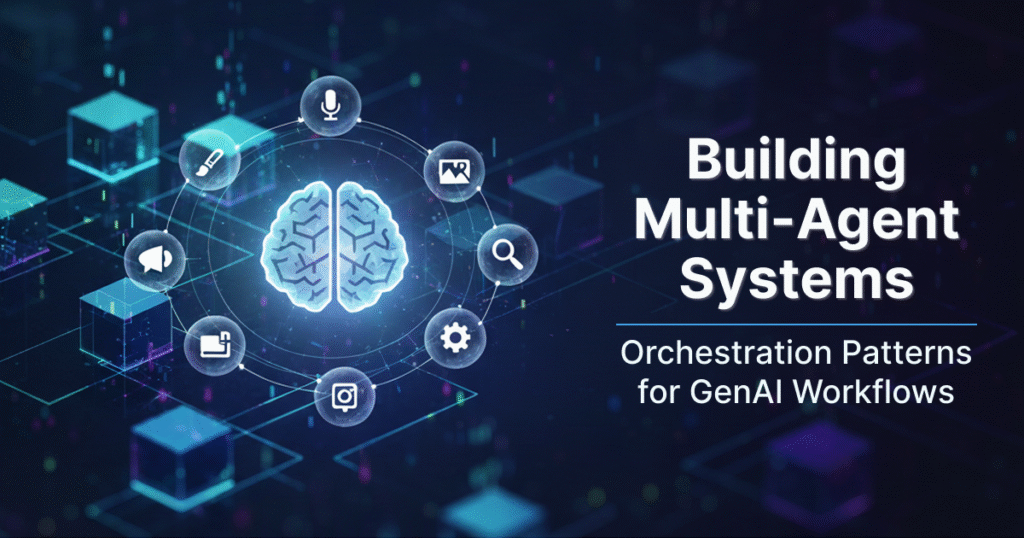
In today’s rapidly evolving AI landscape, multi-agent systems in GenAI workflows are redefining how businesses build, automate, and scale their operations. By enabling multiple intelligent agents to work together, enterprises can achieve outcomes that are faster, smarter, and more adaptive than ever before.
But what exactly are multi-agent systems, and how can they transform the way organizations approach automation and decision-making? Let’s explore how AI agent orchestration, agentic automation, and enterprise AI systems are shaping the future of digital transformation.
What Are Multi-Agent Systems in GenAI Workflows?
A multi-agent system (MAS) is a network of AI agents that work collaboratively to complete complex tasks. Each agent operates independently yet communicates with others to coordinate activities — much like departments in an organization working toward a common business goal.
In GenAI workflows, these agents handle everything from natural language understanding to data retrieval, decision logic, and automated execution. This interconnected approach creates dynamic, scalable workflows where AI handles not just isolated tasks, but entire business processes end-to-end.
AI Agent Orchestration: The Heart of Intelligent Automation
Just like an orchestra needs a conductor, AI agents require coordination to perform harmoniously. This is where AI agent orchestration comes in.
Orchestration defines how agents communicate, delegate, and prioritize tasks. It ensures that every agent — whether managing data, analyzing insights, or generating content — contributes effectively to the workflow.
Modern orchestration frameworks integrate with APIs, knowledge bases, and external tools, enabling real-time decision-making and adaptive responses. Businesses across India, the UAE, and Dubai are leveraging this model to streamline customer service, automate data pipelines, and enhance operational agility.
Agentic Automation: Moving Beyond Traditional AI
While traditional AI focuses on static tasks, agentic automation introduces intelligence that acts with purpose. These autonomous agents can reason, plan, and learn from their environment — making automation more flexible and context-aware.
In enterprise settings, this means:
AI agents can independently manage end-to-end customer queries.
Internal systems can dynamically adjust based on performance metrics.
Organizations can deploy AI that adapts to new business rules without constant human intervention.
For example, an AI-driven support platform in Dubai could use agentic automation to handle thousands of multilingual customer interactions, automatically escalating only complex cases to human agents.
Enterprise AI Systems: Scaling AI for Real-World Impact
Enterprise AI systems combine multiple AI capabilities — including multi-agent orchestration — to deliver value at scale. These systems enable organizations to connect GenAI models with existing business applications like CRM, ERP, and analytics platforms.
Key benefits include:
Seamless workflow automation across departments
Improved decision accuracy through data-driven insights
Enhanced speed, personalization, and scalability in operations
From India’s fast-growing tech hubs to Dubai’s smart city initiatives, enterprises are adopting AI systems that integrate GenAI with their digital ecosystems — driving innovation and productivity simultaneously.
Orchestration Patterns for GenAI Workflows
When building multi-agent systems, certain orchestration patterns ensure reliability and scalability:
1. Hierarchical Orchestration – A lead agent delegates tasks to sub-agents based on priorities.
2. Collaborative Orchestration – Agents share information in real-time for co-decision making.
3. Event-Driven Orchestration – Agents react to triggers (like data updates or user requests) dynamically.
These patterns empower organizations to tailor workflows to their specific business needs — whether it’s automating financial audits in India or optimizing logistics in the UAE.
The Future of Multi-Agent GenAI Workflows
As GenAI continues to evolve, multi-agent orchestration will become the foundation of next-generation enterprise automation. Businesses that invest in scalable, adaptive AI frameworks today will be better equipped to lead tomorrow’s digital economy.
Conclusion: Partner with Brigita for Next-Gen GenAI Solutions
At Brigita, we specialize in end-to-end GenAI and agentic automation solutions that empower enterprises to innovate and scale efficiently. Our multi-agent architectures and workflow orchestration frameworks help global businesses — from India to Dubai — harness AI’s full potential securely and intelligently.
Ready to modernize your workflows with intelligent AI orchestration?
👉 Visit Brigita GenAI Solutions to learn more or contact us today to transform your enterprise with Agentic Automation and Enterprise AI Systems designed for real-world impact.