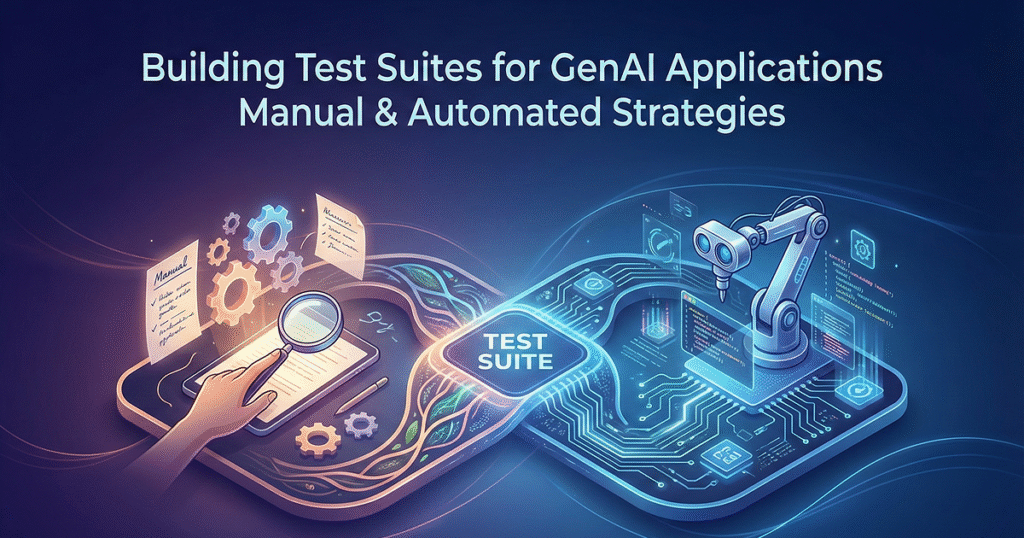
As Generative AI (GenAI) technologies rapidly evolve, they are reshaping industries through intelligent text generation, image synthesis, and autonomous decision-making. However, testing such systems presents new challenges. Unlike traditional software, where outputs are deterministic, GenAI systems produce probabilistic and context-sensitive responses. This unpredictability calls for innovative testing frameworks that combine both manual and automated approaches to ensure reliability, safety, and performance.
Building effective test suites for GenAI applications is now a crucial part of AI engineering. It helps teams validate not only functionality, but also ethical alignment, accuracy, and consistency—key aspects for deploying trustworthy AI systems.
What is GenAI Testing?
GenAI testing is the process of evaluating the performance, correctness, and safety of AI systems that generate outputs such as text, code, images, or decisions. Traditional test cases, which rely on fixed expected outputs, fall short in this context. Instead, GenAI testing involves both quantitative and qualitative assessments.
Manual tests focus on content quality, contextual understanding, and ethical evaluation, while automated strategies handle response validation, performance measurement, and prompt consistency checks.
A well-designed GenAI test suite ensures that AI models behave predictably under diverse inputs, minimizing risks like hallucinations, bias, or harmful responses.
Why GenAI Testing Matters
Testing GenAI applications is critical because:
Outputs vary even for identical prompts due to probabilistic generation.
AI models can produce inaccurate or biased results, impacting trust and usability.
Regulatory frameworks increasingly demand transparency and safety validation.
Enterprises need repeatable testing to ensure consistent model behavior across updates or retraining cycles.
Without structured testing, organizations risk deploying AI systems that are unreliable or even harmful in real-world applications.
Challenges in Testing GenAI Applications
While essential, GenAI testing presents unique challenges compared to traditional QA processes:
Non-Deterministic Outputs: The same input can yield multiple valid responses, complicating test automation.
Lack of Ground Truth: There’s no single “correct” answer for creative or generative tasks.
Subjective Evaluation: Assessing tone, bias, or factual accuracy often requires human judgment.
Prompt Sensitivity: Small wording changes in prompts can significantly alter results.
Model Drift: Model behavior may change over time due to retraining or parameter updates.
Ethical and Safety Concerns: Responses must align with societal norms, avoiding toxicity, discrimination, or misinformation.
Addressing these challenges requires a hybrid approach that balances human expertise with automated repeatability.
Manual Testing Strategies
Manual testing is essential for evaluating qualitative aspects of GenAI systems that machines cannot yet fully judge.
Key Focus Areas:
Factual Accuracy: Ensuring information is correct and verifiable.
Relevance: Checking if responses stay aligned with the prompt intent.
Clarity and Coherence: Assessing logical flow and readability.
Ethical Compliance: Detecting bias, toxicity, or harmful content.
Creativity and Tone: Measuring how natural or engaging outputs feel.
Techniques Used:
Expert reviewers score responses using predefined rubrics.
Comparative testing across multiple models (e.g., GPT vs. Claude).
Context-based scenario testing for edge cases and ambiguity handling.
Manual evaluations provide human judgment that automation alone cannot replicate—especially for ethical and linguistic dimensions.
Automated Testing Strategies
Automated testing introduces scale, speed, and consistency to GenAI validation. It focuses on measurable aspects like API stability, performance, and response patterns.
Common Approaches:
1. Prompt-Response Validation:
Using scripts to send prompts via APIs and verify status codes, latency, and output structure.
Regression Testing:
Comparing outputs before and after model updates to detect behavior changes.
Statistical Similarity Metrics:
Leveraging cosine similarity, BLEU, or ROUGE scores to measure output consistency.
Safety Filters:
Automatically flagging responses that contain bias, offensive content, or misinformation.
Load & Performance Testing:
Measuring how the system performs under concurrent user requests.
Automation Tools:
1. PyTest / Postman – API-based testing and validation.
2. Promptfoo / LangChain Evals – Frameworks for LLM benchmarking.
3. Selenium – UI-driven GenAI application testing.
4. Allure / Power BI – Reporting and visualization.
Automation reduces human effort, enabling continuous integration testing across frequent AI model iterations.
Best Practices for Building Test Suites
To ensure comprehensive coverage, organizations should adopt the following best practices:
1. Define Evaluation Metrics Early: Establish clear qualitative and quantitative benchmarks.
Use Diverse Prompt Sets:
Include factual, creative, and adversarial prompts.
Combine Manual + Automated Checks:
Hybrid validation captures both accuracy and ethics.
Version Control Test Data:
Track prompt evolution and model responses over time.
Integrate with CI/CD Pipelines:
Automate testing during model updates and deployment cycles.
Monitor Model Drift:
Continuously measure performance to detect behavioral changes.
A disciplined testing framework ensures GenAI applications remain reliable, explainable, and compliant.
Real-World Applications
GenAI Testing has become integral across multiple industries:
Healthcare: Validating AI-generated medical summaries for accuracy and safety.
Finance: Ensuring chatbot responses align with compliance guidelines.
Education: Checking fairness and correctness in AI-based tutoring systems.
Marketing: Evaluating tone and brand alignment in automated content generation.
Customer Support: Measuring response relevance and empathy in virtual assistants.
Each sector benefits from tailored testing strategies balancing automation efficiency with human oversight.
Human–AI Collaboration in Testing
Just as in contract testing, collaboration is key in GenAI testing.
Testing teams, data scientists, and domain experts must work together to define evaluation criteria and interpret results.
Human reviewers provide context and nuance.
Automation engineers ensure consistency and efficiency.
AI evaluators (secondary models) bring scalability and pattern recognition.
This triad enables a balanced, holistic testing approach that combines human intelligence with machine precision.
Security and Compliance in GenAI Testing
Testing GenAI systems also supports security, privacy, and compliance:
Validates that generated content adheres to data protection regulations (GDPR, HIPAA).
Ensures sensitive data is not memorized or regenerated.
Tests prompt injection vulnerabilities and data leakage risks.
Checks adherence to AI ethics guidelines such as transparency and fairness.
Embedding compliance validation into testing safeguards both users and organizations.
Live Example: A Global Content Platform
A global digital media company implemented GenAI to automate article summaries and recommendations. However, inconsistencies and factual inaccuracies appeared frequently.
By adopting a hybrid testing framework combining manual review and automated API validation:
Content accuracy improved by 75%
Response latency dropped by 30%
Bias-related incidents reduced by 60%
Continuous testing pipelines ensured safe, scalable AI deployment
This transformation demonstrated that structured GenAI testing directly enhances user trust and operational efficiency.
Conclusion
In the era of Generative AI, testing is no longer an afterthought—it’s a foundation for responsible innovation.
Building comprehensive test suites for GenAI applications demands a blend of manual insight and automated precision.
While manual strategies bring human judgment to evaluate context, tone, and ethics, automation delivers scalability and consistency.
Together, they create a robust framework that ensures GenAI systems are accurate, safe, and dependable—from prototype to production.
As AI continues to evolve, testing will remain the essential bridge between creativity and control—empowering organizations to innovate responsibly while maintaining trust, transparency, and quality.