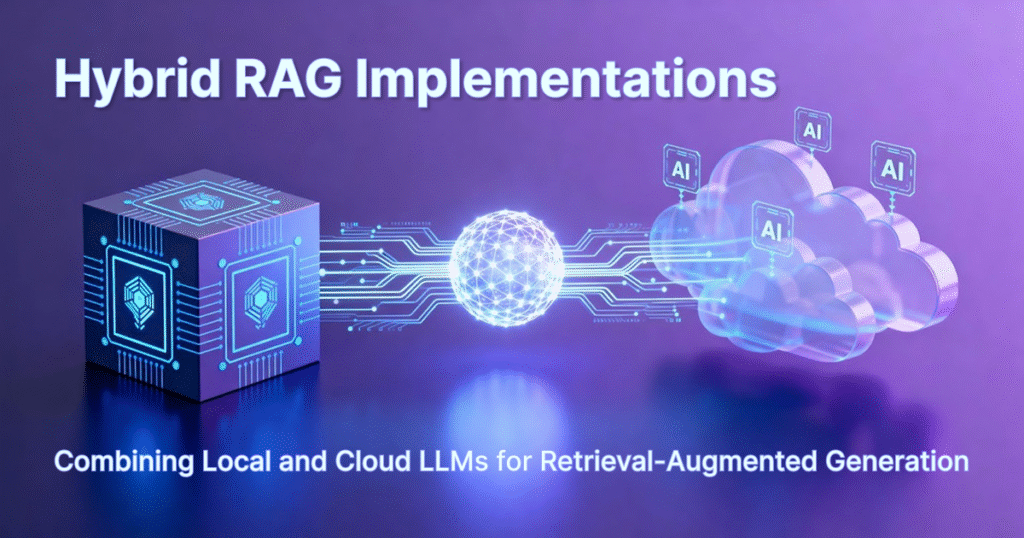
In recent times, Retrieval-Augmented Generation (RAG) has become a powerful approach to make Large Language Models (LLMs) more reliable, accurate, and up-to-date. But as organizations grow, so does their need for flexible and secure RAG systems. That’s where Hybrid RAG comes in — a setup that combines Local and Cloud-based LLMs to get the best of both worlds.
Let’s understand it in a simple way.
What is RAG?
RAG means combining retrieval (searching for information) and generation (creating text) in one process.
For example:
When you ask a chatbot a question, it first searches your company’s documents for relevant info (retrieval), and then uses an LLM to write a meaningful answer (generation).
So basically: RAG = Search + Generate
Why Go Hybrid?
Companies often have sensitive data (like internal reports or client info) that they don’t want to send to the cloud.
At the same time, cloud LLMs (like GPT or Gemini) offer high-quality answers and massive training data.
So, Hybrid RAG gives a balance:
Local LLMs handle private or sensitive data within company servers.
Cloud LLMs handle complex reasoning or large-scale language tasks.
This approach helps ensure data security, cost efficiency, and high performance.
How Hybrid RAG Works
Here’s a simple step-by-step flow:
1. User Query – You ask a question.
2. Retrieval – The system searches local and cloud document databases.
3. Routing – A logic layer decides which LLM to use:
Use Local LLM for confidential data.
Use Cloud LLM for general or complex queries.
4. Generation – The selected LLM creates a response using the retrieved info.
Final Answer – The system combines everything and gives you the best possible answer.
Example Scenario
Imagine you’re in a manufacturing company.
Product manuals, drawings, and process docs are stored locally (private).
Market trends and competitor data are accessible online (public).
If you ask:
“Compare our current product line with new market trends.”
The system will:
Fetch internal product data using a local model (for security).
Fetch market info using a cloud model.
Combine both and generate a detailed, accurate response.
Smart, right?
Benefits of Hybrid RAG
✅ Data Security – Sensitive info stays on-premise.
✅ Cost Optimization – Only use the cloud for tasks that really need it.
✅ High Accuracy – Combines diverse sources for richer answers.
✅ Scalability – Easy to expand as your organization grows.
✅ Custom Control – You decide what runs locally and what goes to the cloud.
Tools & Frameworks to Build Hybrid RAG
Some popular frameworks that support hybrid setups are:
1. LangChain
2. LiamaIndex
3. Haystack
4. OpenAI / Azure API + Local Llama models
Developers can easily integrate both cloud APIs and local open-source models like Llama 3, Mistral, or Falcon.
Conclusion
Hybrid RAG isn’t just a trend — it’s the future of enterprise AI.
It helps teams use the intelligence of cloud LLMs while keeping their data safe with local models.
The result? More accurate, secure, and efficient AI-driven solutions.
In short:
Hybrid RAG = Cloud Power + Local Control = Smart & Safe AI.