
Backend APIs evolve. Teams add fields, rename properties, ship partial responses, or wrap payloads in different envelopes depending on the endpoint. In a small app, you can “just handle it in the component.” In a real Angular codebase, that approach quietly becomes a tax you pay forever: every screen ends up with defensive checks, one-off mappings, and inconsistent error handling.
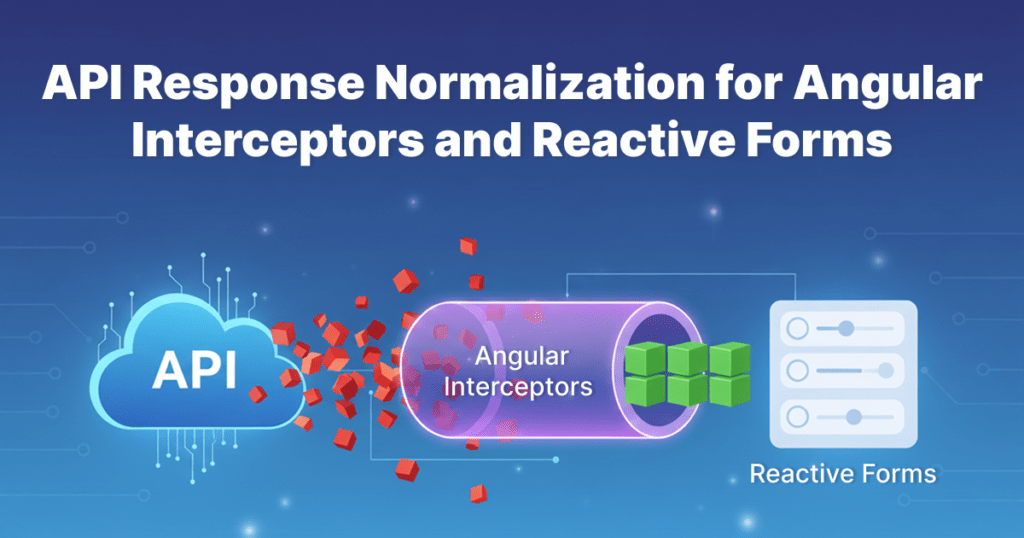
That’s where API Response Normalization in Angular becomes a superpower. The idea is simple: convert every API response—success or error—into a predictable, app-friendly shape before it reaches components and Reactive Forms Data Handling logic. Done right, your UI becomes boring (in the best way): fewer ?., fewer “if it exists” branches, and fewer form patch bugs when data is incomplete.
What “normalization” means in an Angular app
Normalization is a boundary layer. The API can return whatever it wants; your Angular app uses a canonical shape:
Consistent envelope: data, meta, errors
Consistent casing: snake_case → camelCase
Consistent empty values: null → defaults (”, 0, false, [])
Consistent errors: one error object your UI can display and your effects can react to
This is one of the most practical Angular API Integration Techniques you can adopt because it keeps your UI stable even when APIs drift.
Where to normalize: interceptor vs service
A common rule:
Use an interceptor for cross-cutting concerns: envelope shaping, error mapping, logging, auth headers, correlation IDs.
Use a service/adapter for domain mapping: converting DTOs to domain models, combining fields, computing derived values.
In other words, the interceptor makes responses consistent; the adapter makes them meaningful.
This separation is also a core part of Angular Interceptors Best Practices—interceptors shouldn’t become “the place where everything happens.”
A practical normalization contract
Pick one canonical type and stick to it. For example:
ApiEnvelope<T>: { data: T; meta?: {…}; errors?: ApiError[] }
ApiError: { code: string; message: string; details?: any; traceId?: string }
Once you define it, your components stop caring how the backend wraps things. They just consume data or respond to a uniform error object.
Implementing normalization in an interceptor
In an Angular interceptor, you can:
Detect different success shapes ({data: …} vs {result: …} vs raw arrays)
Convert casing
Fill defaults
Map errors into your ApiError structure
The key is to keep the transformation:
Pure (no side-effects)
Idempotent (running it twice doesn’t change the output)
Type-friendly (use HttpClient generics and typed helpers)
A good interceptor also centralizes error handling: whether the backend returns HTTP 400 with errors: [], or HTTP 500 with a different structure, your UI still receives something consistent.
When not to normalize in an interceptor
Avoid interceptors for:
File downloads / blob responses
Streaming endpoints
Extremely large payload transformations (do it in a worker or adapter)
Endpoint-specific logic that only one feature needs
Those exceptions keep you aligned with Angular Interceptors Best Practices.
Reactive Forms: where normalization pays off instantly
Forms hate uncertainty. If a control expects a string but receives null, you get flickery validators, broken UI assumptions, or weird “dirty/pristine” behavior after patching.
With normalized data, Reactive Forms Data Handling becomes predictable:
Every control gets a known default
Optional backend fields map cleanly
Arrays always become arrays (never undefined)
Nested objects don’t explode your FormGroup
Patch vs set: the safe rule
Use patchValue for partial payloads (most edit screens)
Use setValue only when you control the full model and the form is guaranteed to match
Normalization lets you confidently use patchValue without sprinkling ?? ” everywhere.
A clean pattern: DTO → Domain → Form
A scalable approach:
Normalize raw API response into a consistent envelope
Map data (DTO) into a domain model with proper defaults
Build/patch the form from the domain model
On submit, you reverse it:
Form values → domain model
Domain model → API payload (often “denormalized” to the backend’s expected shape)
This pattern is one of the most reliable Angular API Integration Techniques for CRUD-heavy apps.
Testing your normalization layer
If normalization is your boundary, it deserves tests:
Interceptor tests: input raw response shapes → expect canonical envelope
Error mapping tests: simulate HTTP errors → expect consistent ApiError
Form mapping tests: given normalized model → form patched correctly
Once these exist, your feature teams can move faster because they don’t re-solve the same data-shape problems.
Wrap-up
API Response Normalization in Angular is less about clever code and more about removing chaos from your UI. Put a consistent contract at the edge (interceptor + adapter), and the rest of your app becomes simpler: fewer conditional templates, fewer form bugs, and fewer “why did this endpoint return a different shape?” moments.
If your project has more than a handful of screens, this is one of the highest ROI refactors you can do—especially when combined with Angular Interceptors Best Practices, strong typing, and disciplined Reactive Forms Data Handling.
Frequently Asked Questions
1. What is API Response Normalization in Angular?
API Response Normalization in Angular is the process of converting all backend API responses into a consistent format before they reach components or forms. At Brigita, our Angular experts use this method to keep apps stable, predictable, and easy to maintain for clients across India, UAE, USA, Dubai, and GCC.
2. Why does Brigita use Angular interceptors for API normalization?
Angular interceptors allow Brigita developers to standardize response structures, handle errors centrally, and apply default values before data reaches components. This ensures Angular applications behave consistently, even when backend APIs evolve, for projects in India, Dubai, UAE, USA, and GCC markets.
3. How does API normalization improve Reactive Forms in Angular?
Normalized data makes Reactive Forms predictable. Brigita ensures every form control receives valid values instead of null or undefined. This prevents validation errors, broken UI, and patchValue issues, making Angular forms reliable for enterprise apps globally, including UAE, USA, India, Dubai, and GCC regions.
4. Is API Response Normalization useful for large Angular applications?
Yes. For large and complex Angular applications, Brigita applies normalization to reduce repetitive code, simplify maintenance, and ensure consistent data handling across multiple screens. This best practice is especially effective for enterprise clients in India, USA, UAE, Dubai, and GCC.
5. How does Brigita implement API normalization in real projects?
Brigita combines interceptors and service/adapters for clean separation of concerns. Interceptors normalize responses and map errors, while services handle business logic and domain mapping. This approach follows Angular Interceptors Best Practices and delivers scalable, maintainable Angular solutions for clients worldwide, including India, UAE, Dubai, USA, and GCC markets.
