
Generative AI has become one of the most transformative technologies for modern businesses. From automating workflows to building intelligent applications powered by large language models (LLMs), companies are investing heavily in AI to gain a competitive edge.
However, despite the rapid adoption of Generative AI Solutions, many organizations struggle to achieve real business value.
So the key question is:
Why do most Generative AI projects fail—and how can businesses ensure success?
Most Generative AI projects fail due to unclear objectives, poor data quality, lack of technical expertise, and weak implementation strategies. Businesses can succeed by defining clear use cases, leveraging expert GenAI Development Services, and adopting a structured, scalable approach.
The Growing Demand for Generative AI
Businesses across industries are adopting:
AI-powered automation
Content generation tools
Intelligent chatbots
Predictive analytics systems
This surge has led to increased demand for:
Enterprise Generative AI Solutions
Generative AI Consulting Services
Specialized LLM Development Company partnerships
Yet, many projects fail before reaching production or delivering ROI.
Top Reasons Why Generative AI Projects Fail
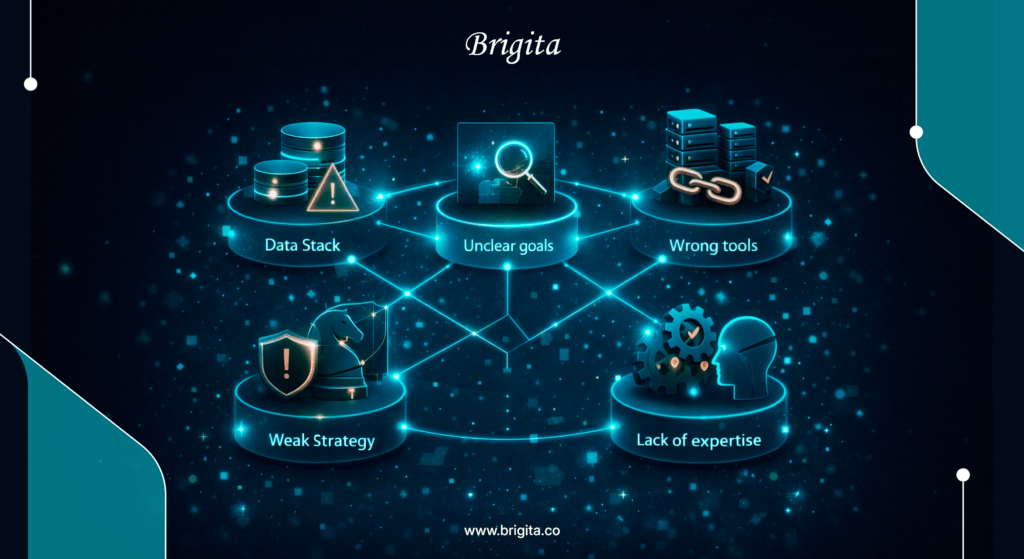
1. Lack of Clear Business Goals
Many organizations jump into AI without defining:
What problem they are solving
What success looks like
How ROI will be measured
Common Mistake:
👉 “We need AI” instead of “We need to solve X problem”
Impact:
Misaligned expectations
Wasted resources
How to Fix:
Start with:
A clear use case
Defined KPIs
Measurable outcomes
2. Poor Data Quality and Readiness
AI models depend heavily on data.
Challenges:
Incomplete datasets
Unstructured information
Data silos across systems
Impact:
Inaccurate outputs
Poor performance
How to Fix:
Clean and structure data
Implement data governance
Ensure data accessibility
3. Lack of Expertise in GenAI Development Services
Generative AI is complex and requires expertise in:
Machine Learning
Natural Language Processing (NLP)
LLM architecture
Many companies lack in-house capabilities.
Impact:
Inefficient models
Increased costs
Delayed timelines
How to Fix:
Partner with experts like Brigita offering end-to-end GenAI Development Services.
4. Choosing the Wrong Tools or Models
Not all AI tools are suitable for every use case.
Common Issues:
Using generic models for specialized tasks
Ignoring scalability
Overengineering solutions
Impact:
Poor performance
High operational costs
How to Fix:
Choose tools based on business needs
Use custom or fine-tuned LLMs when required
5. Weak Implementation Strategy
Even with the right idea, poor execution leads to failure.
Problems:
No clear roadmap
Lack of testing
Poor deployment practices
Impact:
Delays
System inefficiencies
How to Fix:
Follow a structured lifecycle:
Strategy
Data preparation
Model development
Testing
Deployment
6. Lack of Integration with Existing Systems
AI solutions must integrate with:
CRM platforms
ERP systems
Internal tools
Impact:
Disconnected workflows
Reduced efficiency
How to Fix:
Ensure seamless integration during development.
7. Unrealistic Expectations
Many companies expect:
Instant ROI
Perfect results from day one
Reality:
AI systems require:
Training
Iteration
Continuous improvement
How to Fix:
Set realistic expectations and timelines.
8. Ignoring Scalability
A solution that works in testing may fail in real-world scenarios.
Challenges:
High data volumes
Increased user demand
Impact:
Performance issues
System failures
How to Fix:
Build scalable Enterprise Generative AI Solutions from the start.
How to Succeed with Generative AI Projects
Now that we understand the challenges, let’s explore how to build successful AI initiatives.
1. Start with a Clear Use Case
Define:
Business problem
Expected outcome
ROI metrics
2. Invest in Data Quality
Focus on:
Data cleaning
Structuring
Governance
3. Partner with the Right Experts
Working with an experienced LLM Development Company like Brigita ensures:
Proper architecture
Efficient model training
Scalable deployment
4. Use a Structured Development Approach
Step-by-Step Process:
Strategy & consulting
Data preparation
Model development
Testing & validation
Deployment & monitoring
5. Focus on Integration
Ensure AI works seamlessly with existing business systems.
6. Monitor and Optimize Continuously
AI systems improve over time with:
Feedback loops
Model retraining
Performance monitoring
Role of Generative AI Consulting Services
Many successful companies rely on Generative AI Consulting Services to:
Define strategy
Identify use cases
Reduce risks
Ensure ROI
This significantly improves project success rates.
Benefits of Successful Generative AI Implementation
Increased Efficiency
Automation reduces manual effort
Better Decision-Making
Data-driven insights
Enhanced Customer Experience
Personalization at scale
Revenue Growth
New opportunities and business models
Enterprise Perspective: Scaling Generative AI
For large organizations, success depends on:
Scalable infrastructure
Secure systems
Cross-team collaboration
Enterprise Generative AI Solutions must be:
Reliable
Scalable
Integrated
Why Choosing the Right AI Partner Matters
An experienced partner like Brigita provides:
End-to-end GenAI Development Services
Custom AI solutions
LLM-powered applications
Strategic consulting
This ensures:
Faster implementation
Lower risk
Better ROI
Future of Generative AI Projects
The future includes:
AI agents and automation
Advanced LLM applications
Industry-specific AI solutions
Enterprise-scale adoption
Businesses that invest wisely today will lead tomorrow.
Conclusion

Generative AI offers massive potential—but success depends on execution.
The difference between failure and success lies in:
Clear strategy
Strong data foundation
Expert implementation
Scalable systems
By leveraging the right approach and partnering with experts like Brigita, businesses can unlock the full power of Generative AI Solutions and achieve long-term growth.
Ready to Build Successful AI Solutions?
If you’re planning to implement Generative AI, now is the time to take the right approach.
Explore how Brigita can help you design, develop, and scale high-performing AI solutions tailored to your business.
Frequently Asked Questions
1. Why do most Generative AI projects fail?
Most projects fail due to unclear goals, poor data quality, lack of expertise, and weak implementation strategies.
2. What are Generative AI solutions?
Generative AI solutions are systems that create content, automate workflows, and generate insights using AI models like LLMs.
3. What are Enterprise Generative AI solutions?
These are scalable AI systems designed for large organizations to improve efficiency, automation, and decision-making.
4. What are GenAI development services?
GenAI development services include designing, building, and deploying AI-powered applications using generative models.
5. What does a Generative AI consulting service do?
It helps businesses define AI strategies, identify use cases, and implement solutions effectively.
6. What is an LLM development company?
An LLM development company specializes in building applications using large language models for automation and intelligence.
7. How can businesses succeed with Generative AI?
By defining clear goals, using quality data, partnering with experts, and following a structured approach.
Search
Categories
Reach Us
About The Author

Naveen Kumar
Naveenkumar is a seasoned digital marketing professional with over 8 years of experience in SEO, Content Strategy, SaaS Marketing, and Paid Advertising, including Google Ads and Social Media Campaigns. He has worked across diverse industries to create high-performing digital strategies that drive traffic, generate leads, and increase revenue.