
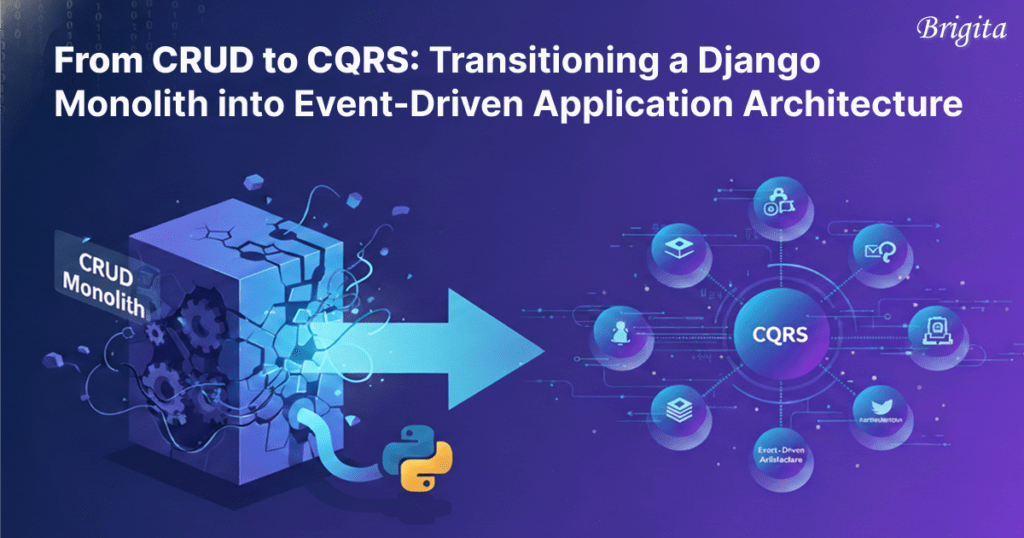
The growth of any successful application inevitably brings both excitement and architectural challenges. For many Django developers, the journey often begins with a comfortable CRUD (Create, Read, Update, Delete) monolith. It’s simple, efficient, and gets the job done. But as traffic surges and features multiply, the tightly coupled nature of CRUD can start to show cracks, leading to performance bottlenecks and scaling headaches.
This is where the power of CQRS (Command Query Responsibility Segregation) comes into play. It’s a fundamental architectural pattern that allows you to break free from the limitations of a monolithic CRUD approach and pave the way for a truly Event-Driven Django application.
The Problem with Traditional CRUD Monoliths
In a typical Django application following the CRUD pattern, the same Model often serves as both the source for saving data (writes) and retrieving it for display (reads). While elegant for smaller applications, this approach introduces several issues at scale:
Performance Bottlenecks: Complex analytical dashboards or heavily filtered lists often require intricate JOINs and aggregations. These expensive read operations can lock tables or significantly slow down your UI, impacting user experience.
Write Contention: Heavy write operations, like bulk imports or complex transactional logic, can block simpler read queries, leading to degraded performance across the entire application.
Rigid Logic: Business rules can become tightly coupled within save() methods, signals, or even scattered across views, making the system harder to understand, test, and maintain.
Scaling Challenges: You’re forced to scale your entire application (both reads and writes) together, even if only one side is experiencing high demand.
Understanding CQRS: Separating Concerns
CQRS offers a solution by explicitly separating the responsibilities of data modification (Commands) from data retrieval (Queries).
Commands: These are objects that represent an intention to change the state of the system. They encapsulate the business logic for creating, updating, or deleting data. Commands are typically validated and then processed, leading to a state change in the write model.
Queries: These are objects designed solely for retrieving data. They access a read-optimized data model, which might be denormalized or structured specifically for display purposes. Queries never change the state of the system.
This segregation allows you to optimize each side independently, leading to more performant and scalable applications.
Phase 1: Logical Separation within Your Django Monolith
Before introducing external services or message brokers, the first step in your CRUD to CQRS journey should be a logical separation of concerns within your existing Django application.
The Command Side (Writes)
Instead of scattering .save() calls directly in your views or business logic, introduce Service Objects or dedicated command handlers.
Goal: To encapsulate all business logic related to a specific state change. This ensures that your database remains consistent and that validation and side effects are handled predictably.
Tools: Simple Python classes, or libraries like django-service-objects, can help you define clear command handlers.
The Query Side (Reads)
Refactor your views to fetch data specifically for display.
Goal: To optimize data retrieval for the UI, often by fetching exactly what’s needed, avoiding unnecessary JOINs, and leveraging efficient database queries.
Tools: Optimized QuerySets using .only(), .defer(), or .values() can greatly reduce database load. Consider using specialized Read Models (simple Pydantic models or namedtuples) that are populated directly from the database for complex UIs, bypassing full ORM object instantiation.
Phase 2: Introducing the Event Bus for Event-Driven Django
The true power of Event-Driven Django emerges when your write side starts notifying the rest of the system about changes. This is where an Event Bus (a message broker) becomes crucial.
The Command Executes: A command handler successfully updates your primary database (the write model).
The Event is Published: Immediately after the state change, an immutable event (e.g., OrderCreated, UserProfileUpdated) is published to a message broker. This event describes what happened, not how it happened.
The Consumers React: Separate, independent processes (consumers) listen for these events. When a relevant event is received, a consumer updates its own Read Model (e.g., a denormalized table, a search index like Elasticsearch, or a cache).
This introduces eventual consistency, meaning the read model might be slightly behind the write model for a brief period, but this is often acceptable for improved performance and scalability.
Phase 3: Leveraging Django CQRS Tools and Infrastructure
While you can build the event-driven system from scratch, several tools can accelerate your Django CQRS transition:
django-cqrs (by Microsoft): This library is designed to help synchronize data between services, making it easier to manage “Master” models (your write side) and “Replica” models (your read side) across different databases or services.
Celery: Essential for handling the asynchronous nature of event processing. Celery workers can consume events from your message broker and update read models in the background.
Message Brokers (RabbitMQ, Kafka): These are the backbone of your event-driven architecture. They reliably store and distribute events, ensuring that all consumers receive messages even if they are temporarily offline.
The Evolution: From Monolith to Distributed System
Feature | Traditional CRUD (Monolith) | Event-Driven Django (CQRS) |
Data Flow | Bidirectional (same model for R/W) | Unidirectional (separate R/W paths) |
Scaling | Scale the entire application together | Scale reads and writes independently |
Consistency | Immediate consistency | Eventual consistency |
Complexity | Lower initial complexity | Higher (more infrastructure, new patterns) |
Data Models | Single, often normalized model | Separate, optimized R/W models |
Responsibility | Tightly coupled R/W logic | Explicitly separated R/W logic |
Conclusion: Embracing the Future of Django Architecture
Transitioning from a CRUD to CQRS architecture in Django is a significant undertaking, but it offers immense rewards in terms of scalability, performance, and maintainability. It’s a strategic move for any growing application looking to evolve into a resilient, Event-Driven Django system.
The journey begins with a mental shift: recognizing that data modification and data consumption are distinct problems. By systematically decoupling your business logic into commands, publishing events, and building read-optimized query models, you can transform your Django monolith into a powerful, adaptable, and highly performant application capable of meeting the demands of modern web development.
Frequently Asked Questions
1. What is CQRS in Django?
CQRS (Command Query Responsibility Segregation) is a pattern that separates write operations (commands) from read operations (queries) to improve performance and scalability. At Brigita, we help implement this in Django for cleaner architecture.
2. Why move away from traditional CRUD?
CRUD monoliths can face slow queries, write contention, and scaling issues. Brigita guides developers to optimize both read and write paths efficiently.
3. How does an event-driven system help?
Event-driven architecture allows Django apps to process changes asynchronously, ensuring faster reads and independent scaling. Brigita leverages this for robust, high-performing apps.
4. Do I need extra tools for Django CQRS?
Yes, tools like django-cqrs, Celery, and RabbitMQ/Kafka make CQRS easier to implement. Brigita integrates these to build seamless event-driven workflows.
5. Is CQRS suitable for all Django projects?
CQRS is ideal for growing applications with high traffic or complex business logic. Brigita evaluates your project and applies CQRS only where it brings clear benefits.
Search
Categories

Author
Ramesh is a highly adaptable tech professional with 6+ years in IT across testing, development, and cloud architecture. He builds scalable data platforms, automation workflows, and translates client needs into technical designs.Proficient in Python, backend systems, and cloud-native engineering.Hands-on with LLM integrations, stock analytics, WhatsApp bots, and e-commerce apps.Mentors developers and simplifies complex systems through writing and real-world examples.Driven by problem-solving, innovation, and continuous learning in the evolving data landscape.
