
Something subtle is happening inside software teams, though it rarely gets discussed in big announcements or strategy decks. You only notice it if you’ve worked closely with testing cycles over the last few years.
The way software is validated is no longer what it used to be.
Quality Engineering used to sit comfortably at the end of the development line. Build the product, test it, fix issues, release it. That sequence made sense when releases were slower and systems were simpler.
That world has mostly disappeared.
Today, software changes continuously. Features are updated in short cycles, sometimes even daily. Users don’t wait for stability windows anymore — they expect everything to just work, all the time.
And somewhere in this pressure, Quality Engineering has started to evolve into something very different.
Generative AI is part of that shift, though not in the dramatic way people often assume. It is not replacing testers. It is quietly changing how testing work actually feels.
At organizations like Brigita, this change shows up in practical ways — less time spent repeating predictable testing work, quicker awareness of risks, and better early visibility into what might break before it reaches production.
Testing No Longer Starts At The End
There was a time when testing began only after development was completed. That separation created structure, but also delay.
That separation doesn’t really exist anymore.
In many teams, testing thinking begins during requirement discussions itself. Sometimes even earlier, when a feature is still being shaped.
At that stage, conversations naturally drift toward risk. What happens if a user behaves differently? What if the system receives unexpected input? What if the design assumptions don’t hold in real usage?
Generative AI fits into this space in a very understated way. It doesn’t provide answers that teams blindly follow. Instead, it expands the list of possibilities.
Some of those suggestions are useful. Some are not. But even the imperfect ones tend to trigger better questions from engineers.
Writing Test Cases is No Longer Starting From Scratch
Anyone who has written test cases manually knows it’s not a mechanical task. It requires imagination — not just of the feature, but of how users will actually behave under pressure, confusion, or error.
Even something simple like login becomes a long list of possibilities once you start thinking seriously about it.
This is where Generative AI has quietly changed the starting point.
Instead of beginning with a blank document, QA engineers often receive a structured draft of scenarios. It is not complete, and it is never final. But it removes the initial friction.
The real work still happens in refining, correcting, and aligning it with business logic.
At Brigita, this is treated more like a collaboration than automation. AI generates the starting structure. Engineers decide what actually matters.
Automation is Improving, But not Magically
Test automation has always had a reputation for being fragile.
Small UI changes, minor updates, or shifting workflows often break scripts. Anyone who has maintained a large regression suite knows how quickly it can become a maintenance burden.
That reality hasn’t disappeared.
But there is a shift happening in how teams interpret failures. Instead of every break being treated as a hard failure, systems are slowly becoming better at distinguishing noise from real issues.
So instead of reacting to every small change, teams spend more time understanding what actually changed in the product.
It’s not perfect, but it reduces unnecessary firefighting.
Quality Work is Becoming More About Prediction Than Reaction
Traditionally, QA has always worked backwards from problems.
Something fails in production → investigate → fix → prevent recurrence.
That cycle still exists, but it is no longer the only model.
By studying historical defects, production logs, and system behavior patterns, Generative AI helps highlight areas that tend to fail more often than others.
Not exact failures. Just risk zones.
And that small difference matters.
Because instead of treating every module equally, teams start prioritizing areas like payment flows, authentication systems, and data-heavy operations where failure impact is higher.
At Brigita, this is increasingly used to guide testing focus before releases rather than reacting after issues appear.
Regression Testing is Becoming More Selective
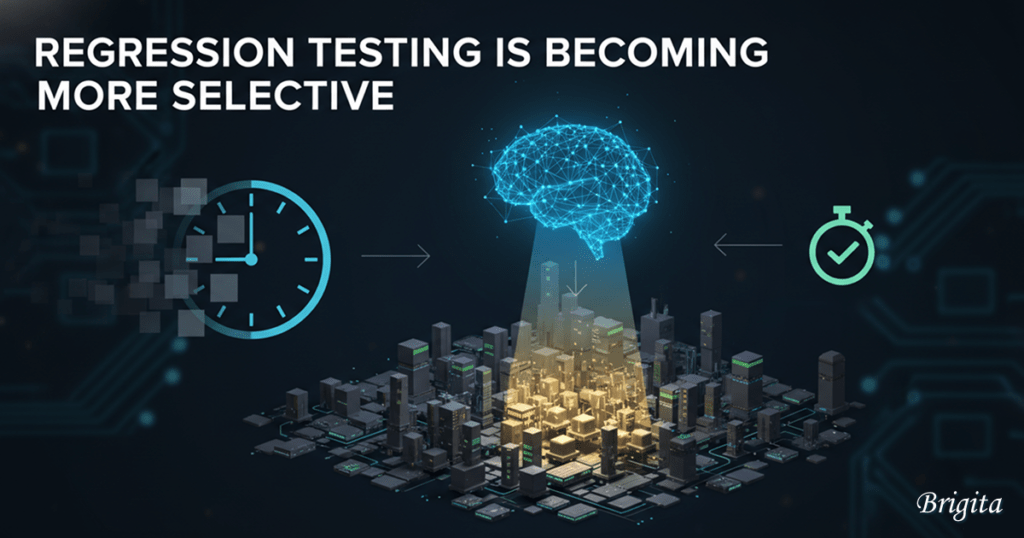
As products grow, regression suites naturally expand. Over time, running everything for every small change becomes impractical.
So teams start asking a simpler question: what actually needs to be tested for this change?
Generative AI helps narrow that scope by identifying impacted areas.
Instead of running everything, teams run what matters for that specific update.
This doesn’t reduce quality. It reduces repetition.
And that change alone saves a surprising amount of time in large systems.
Performance Issues Surface Earlier Than Before
Performance problems are rarely obvious in controlled testing environments.
A system can behave perfectly under limited load and still struggle in real usage conditions.
What’s changing now is the ability to simulate more realistic behavior patterns — not just traffic, but actual user flow.
How users move through the system. Where they hesitate. What they repeat. What they ignore.
These patterns give a more grounded view of how the system behaves under stress.
And when something is going to break, it often becomes visible earlier in the cycle than it used to.
Security is No Longer a Final Checkpoint
Security testing used to sit at the end of the pipeline, almost as a validation step before release.
That model has also shifted.
Now it runs continuously alongside development activity.
AI systems help by flagging unusual patterns or suspicious behavior early. But they don’t replace security expertise. They simply reduce the amount of raw noise engineers have to deal with.
The real work still lies in judgment.
Shift-left is Finally Becoming Practical
Shift-left testing has been discussed for years. The idea was always simple: test earlier in the lifecycle.
But in practice, it was hard to execute consistently.
That is starting to change.
With AI support, testing considerations now appear during requirement discussions instead of after development. This helps teams catch unclear assumptions early, before they become expensive problems later.
At Brigita, this earlier feedback loop is becoming part of normal project flow rather than a separate QA activity.
AI is Useful, But Not Authoritative
It is easy to overestimate what Generative AI can do in testing.
It can suggest scenarios that are too generic. It can miss business-specific logic. And sometimes it can create a false sense of completeness.
That is why human judgment is still central.
The most effective teams are not the ones that rely heavily on AI, but the ones that know when not to trust it blindly.
Integration also matters. Not every system is ready for AI-assisted workflows, and not every team is at the same maturity level.
Where This is Heading
Quality Engineering is slowly shifting away from execution-heavy work.
Instead of focusing only on how many tests were executed, teams are beginning to focus on what risks actually matter before release.
That leads to a more adaptive model of testing — one that is continuous, contextual, and increasingly data-driven.
At Brigita, this direction is already visible in how testing strategies are evolving inside real projects.
Final thought
Generative AI is not transforming Quality Engineering in a dramatic way.
It is changing its rhythm.
Less repetition. More awareness. Better timing. Earlier signals.
And over time, Quality Engineering is becoming less about checking software at the end — and more about shaping its reliability as it is being built.
Frequently Asked Questions
1. How is Generative AI used in Quality Engineering today?
At Brigita, Generative AI is used to support test case design, identify risk areas, and improve regression efficiency by reducing manual effort.
2. Does Generative AI replace QA engineers?
No. QA engineers remain essential for validation, context understanding, and final decision-making. AI only supports and accelerates their work at Brigita.
3. Why is regression testing changing with AI?
Because AI helps identify impacted areas of code changes, allowing teams to run only relevant tests instead of full suites.
4. What is the biggest benefit of AI in QA?
The biggest benefit is faster feedback and reduced repetitive testing work, improving release speed and efficiency.
5. What is the future of Quality Engineering?
Quality Engineering is moving toward continuous, predictive, and AI-assisted validation models integrated throughout the development lifecycle.
Search
Categories
Reach Us
About The Author

Ramesh
Ramesh is a passionate Digital Marketing Specialist with over 4+ years of proven expertise in SEO, social media management, and ad campaign strategies. He has authored insightful blogs on SEO, digital growth, and campaign optimization, helping businesses and startups unlock their online potential. With deep knowledge in on-page and off-page SEO, Google My Business (GMB) optimization, and Google Ads, Ramesh delivers measurable results that boost brand visibility and drive growth. Driven by a commitment to excellence, he combines data-driven strategies with creativity to achieve impactful marketing outcomes. In his free time, Ramesh enjoys playing cricket and spending quality time with friends.