In fast-moving software teams, documentation often becomes the silent casualty of speed. Manual Test Documentation, in particular, is frequently viewed as tedious, outdated, or irrelevant—especially by developers who prefer reading code over documents.
Yet, when written with purpose, manual test documentation can become one of the most powerful collaboration tools between QA and development. The problem isn’t manual testing itself—it’s how the documentation is written.
This article explores how to create manual test documentation that developers don’t just tolerate—but actually read, trust, and use.
The Real Problem with Manual Test Documentation
Most manual test documentation fails for predictable reasons:
It focuses on process over intent
It documents every click, but explains nothing
It lacks technical context
It becomes obsolete as soon as the UI changes
It exists in isolation from the codebase
From a developer’s perspective, such documentation adds little value during debugging, refactoring, or feature development.
Rethinking Manual Tests as Risk Documentation
Developers think in terms of:
Failure points
Edge cases
Data states
System behavior under stress
Effective manual test documentation should reflect this mindset.
Instead of documenting how to use the application, document:
Where the system is fragile
What assumptions exist
Which scenarios are high risk
What happens when things go wrong
In this way, manual test documentation evolves from a checklist into living risk documentation
What Developers Actually Want to See
Manual test documentation that developers read typically shares these characteristics:
1. Clear Intent
Every test explains why it exists.
Example:
“This scenario validates session expiration handling during checkout to prevent silent order failures.”
2. Focus on Edge Cases
Happy paths are assumed. Edge cases are valued.
Examples include:
Invalid inputs
Partial API failures
Permission mismatches
Data boundary conditions
Interrupted user actions
3. Technical Awareness
Good test documentation acknowledges system behavior:
Client-side vs server-side validation
Caching behavior
Async operations
Feature flags
Known limitations
This signals to developers that the test was written with system understanding—not guesswork.
Structuring Manual Test Cases for Developer Readability
Long, step-by-step scripts discourage engagement. A better structure mirrors how developers debug issues.
Recommended Structure:
Test Scenario
Why It Matters
Preconditions
Trigger
Expected Behavior
Notes / Observations
This format allows developers to scan quickly and extract useful information without wading through unnecessary detail.
Checklists Over Scripts: A Smarter Approach
UI-heavy step lists age badly. Exploratory checklists age well.
Instead of rigid scripts, use targeted checklists that highlight coverage:
1. Form validation
2. Error handling
3. Navigation behavior
4. Data persistence
5. State recovery
This approach encourages critical thinking and adapts better to UI changes—while still communicating test intent clearly.
Bringing Documentation Closer to the Code
One reason developers ignore test documentation is simple: they never see it.
High-impact teams keep manual test documentation:
In the same repository as the code
Linked from pull requests
Referenced in Jira stories
Written in Markdown
Updated alongside feature changes
When documentation lives close to development workflows, it becomes part of engineering—not an afterthought.
Manual Test Docs as Knowledge Transfer
Well-written manual test documentation serves a bigger purpose than validation:
It helps onboard new developers
It explains system behavior beyond the code
It captures tribal knowledge
It reduces dependency on individual testers
It supports safer refactoring
In mature teams, manual test documentation becomes a shared mental model of the system
Cultural Shift: From “Proof” to “Insight”
The goal of manual test documentation should not be to prove that testing happened.
The goal should be to:
Share insight
Expose risk
Improve system understanding
Strengthen collaboration between QA and development
When documentation is written with this mindset, developers stop seeing it as noise—and start seeing it as value.
1. Write Test Docs Like a Future Bug Is Guaranteed
Great manual test documentation assumes failure is inevitable.
Instead of:
“Verify the feature works as expected”
Write with the mindset:
“When this breaks in production, how would someone recreate it in 5 minutes?”
This shift changes everything—from tone, to structure, to usefulness.
Developers don’t read docs to feel safe.
2. Every Test Case Is a Mini Design Review
A well-written manual test case quietly reviews the feature design.
It questions:
What assumptions were made?
What happens when those assumptions fail?
What wasn’t explicitly designed?
Developers respect documentation that challenges the system—not just validates it.
3. Manual Tests Should Highlight Trade-offs, Not Just Outcomes
Sometimes behavior isn’t wrong—it’s a compromise.
Good documentation calls this out:
Performance vs accuracy
Security vs usability
Consistency vs speed
When test documentation explains why a limitation exists, developers stop seeing bugs and start seeing decisions.
4. Stop Pretending the System Is Stateless
Real users don’t start fresh every time.
Great manual test documentation includes:
stale session
cached data
partially completed actions
repeated retries
interrupted workflows
Developers care deeply about state-related bugs, and good docs surface them early.
5. Make Failures More Detailed Than Success
Success is boring.
Failure is informative.
Instead of:
“Expected: Error message shown”
Document:
exact message
timing
whether action can be retried
whether data is preserved
whether the system recovers gracefully
This level of detail turns manual tests into debugging accelerators.
6. Manual Test Docs Are a Safety Net for Refactoring
When developers refactor, they don’t re-read requirements—they look for confidence.
High-quality manual test documentation tells them:
which flows are critical
which edge cases must survive
which behaviors are relied upon downstream
In that sense, manual test docs quietly enable faster, safer code change
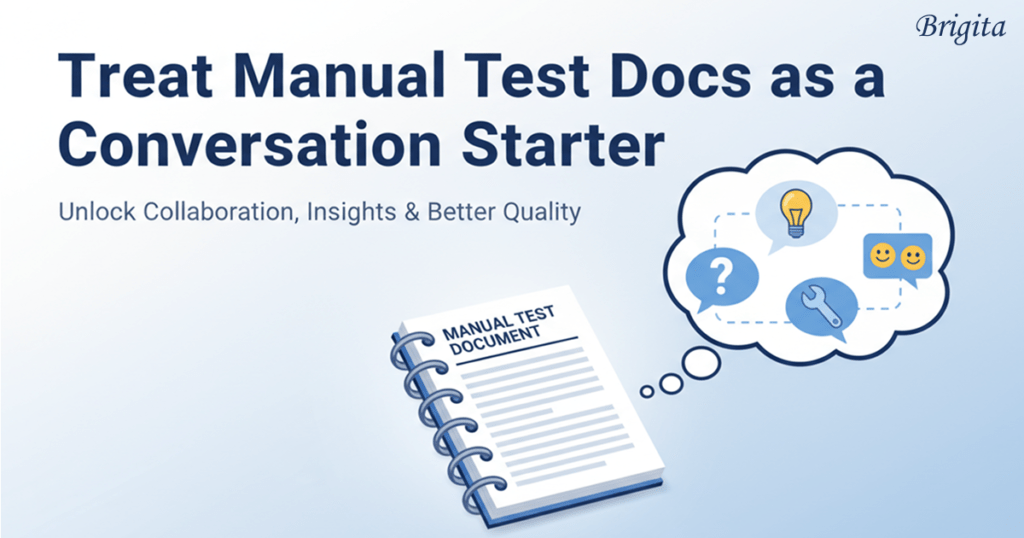
7. Treat Manual Test Docs as a Conversation Starter
The best test documentation invites discussion.
It sparks questions like:
“Should this really behave this way?”
“Is this edge case still valid?”
“Do we still support this?”
When docs trigger conversations, quality improves naturally.
Real-Life Tester vs Developer Anecdotes
1. “It Works on My Machine” vs “It Only Fails After Lunch”
Developer:
“I tested it locally. Works perfectly.”
Tester:
“It fails only after the session sits idle for 20 minutes.”
Turns out the access token expired silently, and the UI didn’t refresh it.
The manual test doc had one line:
“Re-test after session expiry—known weak spot.”
That single sentence saved three hours of debugging in production the following week.
Lesson:
Good test documentation captures time-based failures developers rarely simulate.
2. The Case of the Missing ‘Why’
A tester wrote a test case with the title:
“User cannot submit form twice”
The developer ignored it—until a customer reported duplicate orders.
The tester then added one line to the test documentation:
“This exists because users double-click when the network is slow.”
Suddenly, the developer understood the risk and fixed it properly.
Lesson:
Developers don’t ignore tests—they ignore tests without context.
3. The 42-Step Test Case No One Read
A tester proudly documented every click of a complex workflow.
Forty-two steps. Screenshots included.
The developer scrolled once… then closed the document.
Later, during a bug fix, the developer asked:
“Is there anything tricky in this flow?”
The tester replied:
“Yes—refreshing mid-way loses unsaved state.”
That wasn’t in the 42 steps.
Lesson:
Length hides insight.
Developers want risks, not replay instructions.
4. “Not a Bug, It’s Expected” (But Only QA Knew That)
A developer marked a bug as “Invalid.”
The tester replied:
“It’s expected because the backend doesn’t validate this field.”
Silence.
The tester then added a Dev Note to the test doc:
“Validation is client-side only; backend accepts invalid values.”
The same issue never came back again.
Lesson:
Manual test docs should document system limitations, not just behavior.
5. The Bug That Only Appeared After Refresh
A tester reported:
“Data saves successfully, but disappears after refresh.”
The developer couldn’t reproduce it.
The tester checked the manual test notes:
“This fails only when the cache is cold.”
That one line led directly to a caching issue.
Lesson:
Great test documentation captures conditions, not just results.
6. “We Never Tested That” (And Everyone Was Glad They Knew)
A tester added a section called:
What We Didn’t Test
It listed:
unsupported browsers
rare edge cases
skipped scenarios due to time
A production issue later happened in one of those areas.
Nobody panicked.
Lesson:
Honest documentation builds trust faster than perfect documentation.
7. When a Developer Finally Said “This Is Useful”
After months of ignored test cases, a developer messaged:
“The new test notes actually helped me debug faster.”
What changed?
The tester stopped writing how-to-use instructions
and started writing how-it-breaks notes.
Lesson:
Developers read documentation that saves time.
Conclusion
Manual Test documentation doesn’t get ignored because it’s manual.
It gets ignored when it adds noise instead of insight.
When test docs focus on how things break, why scenarios matter, and where risks live, developers read them—because they save time and reduce uncertainty. The most valuable documentation isn’t verbose or perfect; it’s honest, contextual, and grounded in real system behavior.
Write manual test documentation as shared engineering knowledge, not as a formality.
When you do, it stops being skipped—and starts being trusted.
Frequently Asked Questions
1. Why do developers ignore manual test documentation?
Developers often ignore manual testing documentation when it lacks context, edge case coverage, or risk clarity. At Brigita, we focus on QA documentation, risk-based testing, and real system behavior insights so developers see value—not noise.
2. How can manual test cases support Agile teams?
In Agile testing environments, test cases must be concise and insight-driven. Brigita aligns test case design, shift-left testing, and continuous testing practices to improve Dev-QA collaboration and faster debugging cycles.
3. What makes test documentation developer-friendly?
Developer-friendly test documentation highlights edge case testing, session handling, API failures, and system state behavior. At Brigita, we structure documentation to support debugging, regression testing, and refactoring safety.
4. Is manual testing still relevant in DevOps?
Yes. In DevOps testing, manual testing supports exploratory validation and quality engineering insights. Brigita integrates manual testing with automation to improve software quality and prevent production bugs.
5. How does strong QA documentation reduce bugs?
Well-written QA documentation improves test coverage, strengthens bug prevention, and supports long-term test strategy. At Brigita, we treat documentation as shared engineering knowledge that improves system reliability.