
Generative AI is rapidly becoming part of enterprise technology strategies in 2026. Businesses are using Large Language Models (LLMs) for enterprise search, customer support, document intelligence, workflow automation, knowledge management, and intelligent applications.
But when businesses want to customize AI for their specific requirements, an important question comes up:
Should you choose RAG or fine-tuning?
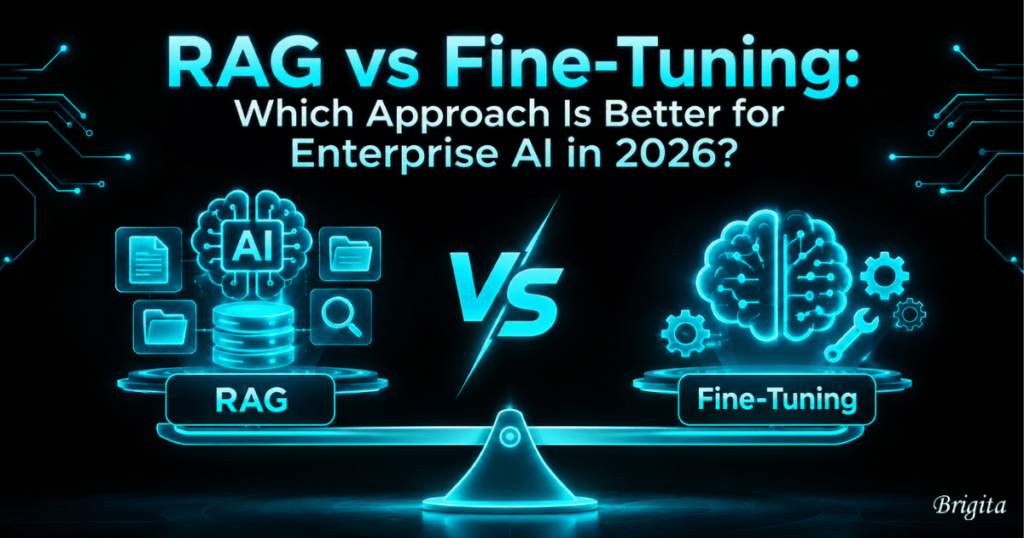
Both approaches can improve the capabilities of generative AI, but they solve different problems. Retrieval-Augmented Generation (RAG) connects an LLM with external or enterprise data, while fine-tuning adapts a model’s behavior using specialized training data.
For enterprises planning GenAI implementation, understanding the difference between RAG and fine-tuning is important for choosing the right architecture, controlling costs, improving accuracy, and scaling AI applications.
Brigita helps businesses evaluate and implement enterprise GenAI solutions, including RAG implementation, custom LLM development, enterprise AI search, LLMOps, and GenAI workflow automation.
What Is RAG in Enterprise AI?
Retrieval-Augmented Generation (RAG) is an AI architecture that allows an LLM to retrieve relevant information from external data sources before generating an answer.
Instead of relying only on information learned during model training, RAG connects the AI model with business-specific information.
Enterprise data can include:
-
Company documents
-
Knowledge bases
-
Product documentation
-
Policies and SOPs
-
CRM data
-
ERP information
-
Databases
-
Internal websites
-
Reports
-
Technical documentation
A typical enterprise RAG workflow looks like:
Enterprise Data → Data Processing → Indexing → Retrieval → Relevant Context → LLM → Response
This approach is particularly useful when business information changes frequently.
For example, if a company’s internal policy changes, the RAG system can retrieve the updated policy from the connected knowledge source rather than requiring the LLM to be retrained.
Brigita’s RAG Implementation services help businesses connect enterprise information with GenAI applications to create more relevant and context-aware AI experiences.
What Is Fine-Tuning in Enterprise AI?
Fine-tuning involves additional training of a pretrained LLM using a specialized dataset.
The objective is to make the model perform better for a particular task, behavior, format, or domain.
Fine-tuning can be useful when businesses need:
-
Consistent response formats
-
Specialized task performance
-
Domain-specific behavior
-
Consistent tone and style
-
Classification capabilities
-
Structured outputs
-
Specialized instructions
For example, a company may want an AI model to consistently classify support tickets into predefined categories.
Fine-tuning can help the model learn that specific behavior from suitable training examples.
Through Custom LLM Development, Brigita can help businesses explore model customization and specialized AI solutions based on their business requirements.
RAG vs Fine-Tuning: Key Differences
|
Factor |
RAG |
Fine-Tuning |
|
Primary purpose |
Access external knowledge |
Customize model behavior |
|
Changing information |
Excellent |
Less suitable |
|
Enterprise documents |
Excellent |
Not usually the first choice |
|
Model behavior |
Moderate customization |
Strong customization |
|
Data freshness |
High |
Requires additional training |
|
Specialized task |
Good |
Excellent |
|
Enterprise search |
Excellent |
Limited |
|
Implementation |
Retrieval pipeline required |
Training process required |
|
Best suited for |
Knowledge-intensive applications |
Specialized tasks |
The simplest way to understand the difference is:
RAG teaches the AI what information to use. Fine-tuning teaches the AI how to behave.
When Should Enterprises Choose RAG?
RAG is a strong choice when an enterprise wants AI to work with frequently changing business information.
Consider an organization with thousands of internal documents. Employees may ask:
“What is our latest employee leave policy?”
A RAG system can retrieve the latest policy from the company’s knowledge base and provide an answer based on that information.
RAG is particularly useful for:
Enterprise Knowledge Assistants
Employees can interact with internal company knowledge using natural-language questions.
AI-Powered Enterprise Search
Employees can search across large collections of business information without relying only on exact keywords.
Brigita’s GenAI-Powered Enterprise Search capability is designed for this type of enterprise use case.
Customer Support
AI can retrieve current product information, FAQs, documentation, and support resources before generating an answer.
Document Intelligence
Businesses can connect AI applications with contracts, reports, manuals, and other documents.
Internal Business Assistants
Organizations can create AI assistants that work with their internal knowledge and information sources.
When Should Enterprises Choose Fine-Tuning?
Fine-tuning becomes more relevant when the primary goal is to customize how an AI model performs a specific task.
For example, a business may require an AI system to consistently:
-
Generate a specific JSON structure
-
Classify documents
-
Follow a particular communication style
-
Produce standardized outputs
-
Perform a specialized business task
-
Follow domain-specific instructions
Fine-tuning can be valuable when a company has a high-quality dataset containing examples of the desired behavior.
However, fine-tuning isn’t always the best solution for frequently changing company information.
If the main requirement is giving an AI system access to updated enterprise knowledge, RAG is often more practical.
Brigita can help enterprises assess whether RAG, custom LLM development, or another GenAI architecture is appropriate for their particular business requirement.
RAG vs Fine-Tuning: Which Is Better for Enterprise AI?
There isn’t one solution that is best for every business.
The right choice depends on the problem you want to solve.
Choose RAG when:
-
Business information changes regularly
-
AI needs access to internal documents
-
You need enterprise knowledge retrieval
-
You are building an AI-powered search system
-
Information comes from multiple business systems
-
You need responses based on current data
Choose Fine-Tuning when:
-
You need specialized model behavior
-
You require consistent output formats
-
You have high-quality training examples
-
You need specialized task performance
-
You want consistent tone or style
Consider Both When:
Some enterprise applications can benefit from a RAG + fine-tuning approach.
For example:
Fine-Tuned LLM + RAG + Enterprise Data
Fine-tuning can customize the model’s behavior while RAG provides access to current business information.
This hybrid architecture can be useful for complex enterprise GenAI applications.
RAG vs Fine-Tuning: Cost and Maintenance
Cost should also be considered before selecting an AI architecture.
A RAG implementation requires components such as:
-
Data pipelines
-
Embeddings
-
Vector databases
-
Retrieval systems
-
Security controls
-
Evaluation
-
Monitoring
Fine-tuning requires:
-
High-quality training data
-
Training infrastructure
-
Model evaluation
-
Model version management
-
Ongoing optimization
Therefore, enterprises should evaluate more than the initial development cost.
Important factors include:
-
Data update frequency
-
Infrastructure
-
Model costs
-
Maintenance
-
Security
-
Scalability
-
Accuracy
-
Performance
-
Governance
Brigita’s LLMOps & Model Governance capabilities can help enterprises manage AI systems more effectively as they move from experimentation toward production.
Why Enterprise Data Matters for RAG
The performance of a RAG system depends heavily on the quality of the information it retrieves.
Poor-quality enterprise data can result in:
-
Irrelevant responses
-
Missing context
-
Outdated information
-
Duplicate content
-
Incorrect answers
-
Poor retrieval performance
That’s why enterprise RAG involves more than simply connecting an LLM to a vector database.
A production-ready RAG architecture may include:
Data Ingestion → Data Cleaning → Chunking → Embeddings → Indexing → Retrieval → Reranking → Context Management → LLM → Evaluation
Brigita’s Multi-Source Data Integration for GenAI services can support businesses that need to bring information from different enterprise sources into their GenAI ecosystem.
How to Choose Between RAG and Fine-Tuning
Before choosing an approach, enterprise teams should ask several questions.
Does your business information change frequently?
If yes, RAG may be the better starting point.
Does your AI need access to internal company knowledge?
If yes, RAG is highly relevant.
Do you need to change how the model performs a specific task?
If yes, fine-tuning may be appropriate.
Do you need both current knowledge and specialized behavior?
A combination of RAG and fine-tuning may be worth evaluating.
Do you have high-quality training data?
If you are considering fine-tuning, the quality and quantity of training examples are important.
Brigita can help organizations evaluate these requirements and select an enterprise GenAI architecture aligned with their business goals.
Why RAG Is Important for Enterprise AI in 2026
Enterprise AI is moving beyond basic AI chatbots.
Businesses increasingly want AI systems that can understand and work with their own:
-
Business processes
-
Customer information
-
Internal documentation
-
Product information
-
Policies
-
Operational data
-
Industry knowledge
This is making enterprise RAG an important component of modern GenAI architectures.
For businesses with large and frequently changing knowledge bases, RAG can provide a practical way to connect LLMs with current enterprise information.
Brigita’s GenAI Solutions combine capabilities such as RAG, custom LLM development, enterprise AI search, workflow automation, data integration, and LLMOps to help businesses build production-focused AI solutions.
How Brigita Helps Businesses with Enterprise GenAI
Selecting RAG or fine-tuning is only one part of an enterprise AI strategy.
Brigita provides a range of GenAI services designed around enterprise requirements, including:
-
Custom LLM Development
-
RAG Implementation
-
LLMOps & Model Governance
-
GenAI-Powered Enterprise Search
-
GenAI Workflow Automation
-
Domain-Specific Prompt Engineering
-
Multi-Source Data Integration for GenAI
-
GenAI Content Generation
-
Agentic AI Solutions
These capabilities help businesses move from individual AI experiments toward scalable and production-ready GenAI applications.
Whether an organization needs an internal knowledge assistant, enterprise search platform, customized LLM solution, or automated AI workflow, Brigita can help identify the right technology approach based on the business use case.
Conclusion
RAG and fine-tuning serve different purposes in enterprise AI.
RAG is generally better when businesses need AI to access current, proprietary, and frequently changing information.
Fine-tuning is more appropriate when businesses need to customize model behavior, task performance, response format, or style.
For complex enterprise applications, a hybrid RAG and fine-tuning architecture may provide the benefits of both approaches.
The right decision should be based on your business objectives, data, accuracy requirements, security, scalability, and AI use case rather than simply following the latest AI trend.
With expertise across RAG implementation, custom LLM development, enterprise AI search, data integration, LLMOps, and GenAI workflow automation, Brigita helps businesses design and implement GenAI solutions aligned with their enterprise requirements.
Frequently Asked Questions
1. Is RAG better than fine-tuning for enterprise AI?
RAG is often a strong choice for enterprise applications that need access to frequently changing business information. Fine-tuning is more suitable when the main requirement is specialized model behavior or task performance.
2. What is the main difference between RAG and fine-tuning?
RAG provides relevant external information to an LLM during the generation process, while fine-tuning uses additional training to change the model’s behavior. Simply put, RAG focuses on knowledge, while fine-tuning focuses on behavior.
3. Can RAG and fine-tuning be used together?
Yes. Enterprises can combine RAG with fine-tuning when they need both access to current enterprise knowledge and customized model behavior.
4. When should a business choose RAG?
Businesses should consider RAG when they need AI to work with internal documents, knowledge bases, product information, policies, databases, or other enterprise data that may change over time.
5. How can Brigita help with RAG and fine-tuning?
Brigita provides RAG Implementation and Custom LLM Development, along with enterprise AI search, LLMOps and model governance, data integration, prompt engineering, and GenAI workflow automation to help businesses build scalable enterprise AI solutions.
Search
Categories
Reach Us
About The Author

Ramesh
Ramesh is a passionate Digital Marketing Specialist with over 4+ years of proven expertise in SEO, social media management, and ad campaign strategies. He has authored insightful blogs on SEO, digital growth, and campaign optimization, helping businesses and startups unlock their online potential. With deep knowledge in on-page and off-page SEO, Google My Business (GMB) optimization, and Google Ads, Ramesh delivers measurable results that boost brand visibility and drive growth. Driven by a commitment to excellence, he combines data-driven strategies with creativity to achieve impactful marketing outcomes. In his free time, Ramesh enjoys playing cricket and spending quality time with friends.