
Data Engineering sits at the core of modern digital businesses. Every app, dashboard, and AI model depends on reliable, well-structured data pipelines. Yet, as data volumes explode and systems grow more complex, teams face constant friction—broken pipelines, inconsistent data, and scalability issues.
This is where AI-driven platforms like Brigita (often referred to as Brigita AI) are changing the game. By combining automation, intelligence, and real-time insights, AI is redefining how organizations handle data engineering challenges.
In this guide, we’ll break down the most common data engineering problems—and how AI (including solutions like Brigita AI) solves them efficiently.
What Is Data Engineering?
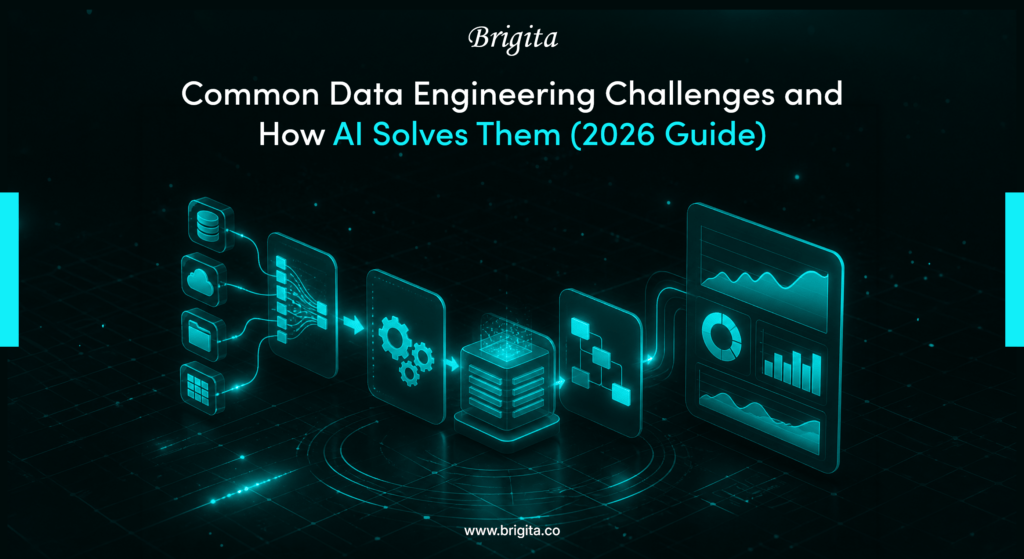
Data engineering involves designing, building, and maintaining systems that collect, store, and process data. These systems power analytics, machine learning, and business decision-making.
A typical data engineering workflow includes:
Data ingestion
Data transformation (ETL/ELT)
Data storage (warehouses/lakes)
Data quality checks
Data delivery for analytics
However, as systems scale, challenges become inevitable.
Why Data Engineering Is Getting Harder in 2026
Several trends are increasing complexity:
Massive data growth (structured + unstructured)
Real-time data expectations
Multi-cloud and hybrid environments
Increasing demand for AI-driven insights
Data compliance and governance requirements
Traditional tools struggle to keep up. That’s why AI-powered platforms like Brigita are gaining traction.
Common Data Engineering Challenges (and AI Solutions)
1. Data Silos Across Systems
The Problem
Organizations often store data across multiple platforms—CRMs, ERPs, cloud apps, and databases. These disconnected systems create data silos, making it hard to get a unified view.
AI Solution
AI tools automatically:
Discover data sources
Integrate APIs and databases
Create unified data models
Platforms like Brigita simplify integration by automating data mapping and reducing manual effort.
2. Poor Data Quality
The Problem
Bad data leads to poor decisions. Common issues include:
Missing values
Duplicate records
Inconsistent formats
AI Solution
AI can:
Detect anomalies in real time
Auto-clean and standardize data
Flag inconsistencies before they impact reports
With Brigita AI, data validation becomes automated, ensuring clean and reliable datasets.
3. Complex ETL Pipelines
The Problem
Building ETL (Extract, Transform, Load) pipelines is time-consuming and error-prone. Changes in source systems can break pipelines.
AI Solution
AI-powered platforms:
Auto-generate ETL workflows
Adapt to schema changes
Suggest optimizations
Brigita reduces manual coding and speeds up pipeline creation significantly.
4. Scalability Issues
The Problem
As data grows, pipelines slow down or fail. Scaling infrastructure manually is costly and inefficient.
AI Solution
AI systems:
Automatically scale resources
Optimize workloads
Predict future capacity needs
This ensures high performance even with large datasets.
5. Real-Time Data Processing Challenges
The Problem
Businesses need real-time insights, but traditional batch processing causes delays.
AI Solution
AI enables:
Stream processing
Real-time analytics
Instant anomaly detection
Brigita AI helps process data in real time, enabling faster decision-making.
6. Data Pipeline Failures
The Problem
Pipelines break due to:
Schema changes
API failures
Infrastructure issues
AI Solution
AI tools:
Monitor pipelines continuously
Predict failures before they happen
Auto-fix common errors
Platforms like Brigita provide proactive monitoring and alerts.
7. High Maintenance Costs
The Problem
Maintaining pipelines requires constant manual effort from engineers.
AI Solution
AI reduces:
Manual intervention
Debugging time
Operational costs
Automation allows teams to focus on strategy instead of maintenance.
8. Lack of Data Governance
The Problem
Without proper governance:
Data becomes inconsistent
Compliance risks increase
AI Solution
AI enforces:
Data policies
Access control
Audit tracking
This ensures secure and compliant data usage.
9. Skill Shortage
The Problem
There’s a growing shortage of skilled data engineers.
AI Solution
AI tools simplify workflows so that:
Non-technical users can build pipelines
Teams become more productive
Brigita lowers the barrier to entry for data engineering.
10. Slow Time-to-Insight
The Problem
Traditional workflows delay insights, affecting business decisions.
AI Solution
AI accelerates:
Data processing
Reporting
Decision-making
Brigita AI enables faster insights through automation and real-time analytics.
How Brigita AI Transforms Data Engineering
Brigita is designed to simplify modern data workflows using AI.
Key Benefits:
Automated data pipelines
Real-time processing
Intelligent data cleaning
Scalable infrastructure
Easy integration with multiple data sources
By reducing manual effort, Brigita AI allows teams to focus on innovation rather than operations.
Best Practices for AI-Driven Data Engineering
- Use automation wherever possible
- Focus on data quality from the start
- Implement real-time processing
- Choose scalable cloud solutions
- Leverage AI platforms like Brigita
Future of Data Engineering with AI
AI is not replacing data engineers—it’s enhancing them.
In the future, expect:
- Fully automated pipelines
- Self-healing data systems
- AI-driven data architecture
- Increased adoption of platforms like Brigita AI
Conclusion
Data Engineering is becoming more complex, but AI is making it more manageable. From automating pipelines to improving data quality, AI-driven solutions are solving the biggest challenges faced by modern organizations.
Platforms like Brigita are leading this transformation, helping businesses unlock the full potential of their data.
For companies looking to stay competitive in 2026 and beyond, adopting AI in data engineering is no longer optional—it’s essential.
Frequently Asked Questions
1. What are common challenges in data engineering?
Common challenges include data silos, poor data quality, pipeline failures, scalability issues, and slow processing speeds.
2. How does AI help in data engineering?
AI automates data pipelines, improves data quality, predicts failures, and enables real-time analytics.
3. What is Brigita AI?
Brigita is an AI-powered platform that simplifies data engineering through automation and intelligent workflows.
4. How does Brigita AI improve data pipelines?
Brigita AI automates pipeline creation, monitors performance, and fixes issues in real time.
5. Is data engineering a good career in 2026?
Yes, data engineering remains a high-demand career due to the increasing need for data-driven decision-making.
6. What is ETL in data engineering?
ETL stands for Extract, Transform, and Load—a process used to move and prepare data for analysis.
7. How can businesses solve data engineering problems?
Businesses can adopt AI-powered platforms like Brigita to automate workflows and improve efficiency.
8. What is the future of data engineering?
The future includes AI-driven automation, real-time processing, and scalable cloud-based systems.
Search
Categories
Reach Us
About The Author

Naveen Kumar
Naveenkumar is a seasoned digital marketing professional with over 8 years of experience in SEO, Content Strategy, SaaS Marketing, and Paid Advertising, including Google Ads and Social Media Campaigns. He has worked across diverse industries to create high-performing digital strategies that drive traffic, generate leads, and increase revenue.