
Businesses are collecting more data than ever—from customers and sales to operations, finance, marketing, and market trends. But having more data does not automatically lead to better decisions.
The real challenge is turning complex business data into clear, useful insights.
This is where Business Intelligence (BI) comes in. By organizing and analyzing information, business intelligence helps organizations understand what is happening, identify meaningful patterns, and use insights to make more informed decisions.
For businesses looking to turn information into intelligence, Brigita brings together a connected approach to understanding business data and supporting smarter action.
What Is Business Intelligence?
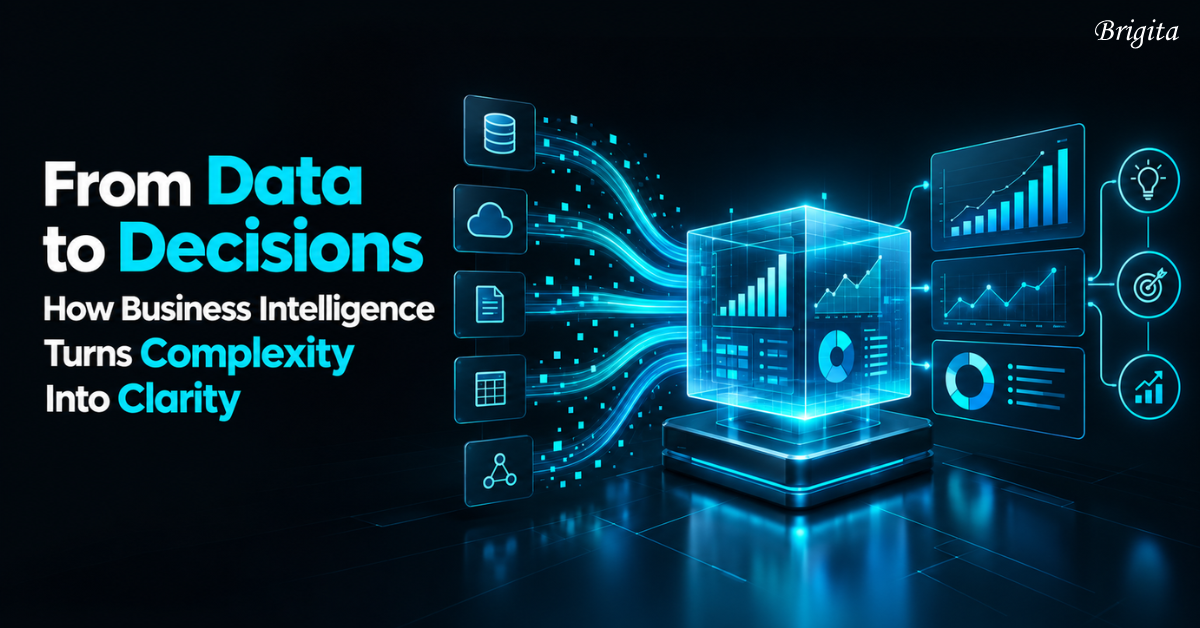
Business Intelligence is the process of collecting, organizing, analyzing, and presenting business information to help organizations understand performance and make informed decisions.
Instead of relying on disconnected spreadsheets, reports, or individual data sources, BI creates a clearer way to look at information.
Business intelligence can help answer questions such as:
What is happening in the business?
What trends are emerging?
Which areas need attention?
Where could new opportunities exist?
What information can support the next business decision?
The goal is not simply to collect more data. It is to turn the right data into meaningful business intelligence.
Why Businesses Struggle With Data Complexity
Data is often spread across multiple systems and departments. Sales teams may have customer information, finance teams may have financial data, operations may track performance separately, and marketing teams may monitor campaign results.
When these sources are viewed independently, important connections can be difficult to see.
This can lead to:
Information being difficult to find
Repetitive reporting
Limited visibility across business functions
Difficulty identifying important trends
Slow decision-making
Too much information without enough context
The challenge is therefore not just having data. It is understanding how different pieces of information fit together.
How Business Intelligence Turns Data Into Decisions
A useful business intelligence process moves through several important stages.
1. Collect Relevant Data
The first step is identifying and gathering the information that matters to the business.
This could include customer data, sales performance, operational metrics, financial information, market research, or other business sources.
Relevant and reliable information creates a stronger foundation for analysis.
2. Organize and Connect Information
Data becomes more useful when related information can be viewed together.
Connecting relevant sources can help businesses develop a broader understanding of their operations, customers, markets, and performance.
This reduces the need to analyze every source in isolation.
3. Analyze the Bigger Picture
Once information is organized, businesses can examine trends, relationships, changes, and patterns.
Instead of asking only “What happened?”, teams can begin exploring questions such as “Why did it happen?” and “What should we consider next?”
This is where raw data begins to become useful intelligence.
4. Turn Insights Into Action
Insights have the greatest business value when they can support real decisions.
Decision-makers can use relevant intelligence alongside business goals, experience, and context to evaluate opportunities, address challenges, and determine appropriate next steps.
That is the journey from data to decisions.
The Difference Between Data and Business Intelligence
Data and business intelligence are closely connected, but they are not the same.
Data is the information a business collects.
Business intelligence is the process of understanding that information and using it to generate meaningful insights.
For example, a sales report may show that revenue changed during a particular period. Business intelligence can help place that change into context by examining relevant customer, product, market, or operational information.
The value comes from moving beyond numbers toward understanding.
How Brigita Helps Create Business Clarity
Brigita focuses on helping businesses navigate complex information and turn it into meaningful intelligence.
By connecting relevant business information and providing a broader perspective, Brigita supports organizations that want to better understand their data and use that understanding in decision-making.
The approach is centered on a simple principle:
Connect information. Understand what matters. Act on meaningful intelligence.
This helps position business intelligence as more than reporting. It becomes a way to create greater clarity around business questions and decisions.
Key Benefits of Business Intelligence
When implemented effectively, business intelligence can help businesses:
Improve Visibility
BI can provide a clearer view of business performance by bringing relevant information into one broader perspective.
Identify Trends
Analyzing business data can help teams recognize changes and patterns that may otherwise be difficult to spot.
Support Data-Driven Decisions
Decision-makers can use relevant evidence and insights alongside their business knowledge when evaluating different options.
Discover Opportunities
Understanding customer, market, and operational information can help businesses identify areas worth exploring.
Reduce Information Complexity
Organized intelligence can make large amounts of business information easier to interpret and communicate.
Improve Strategic Planning
Clearer information can support planning by giving teams a stronger understanding of current conditions and relevant trends.
Business Intelligence Is More Than a Dashboard
A dashboard can display information, but business intelligence goes beyond simply presenting numbers on a screen.
Effective BI is about answering meaningful business questions.
A useful business intelligence approach should help organizations move from:
Data → Information → Insight → Decision
Each stage adds context and meaning.
For Brigita, this means focusing on the intelligence businesses need to understand complexity and make informed decisions—not simply producing more reports.
Why Data-Driven Decision-Making Matters
Business decisions are often influenced by many factors. Data can provide an important source of evidence, while business expertise and strategic objectives provide additional context.
Business intelligence brings relevant information into the decision-making process so teams can better understand the situation they are evaluating.
This can be especially valuable when businesses operate across multiple markets, teams, systems, and information sources.
The objective is not to replace human decision-making. It is to give decision-makers clearer information to work with.
The Future of Business Intelligence
As businesses continue to generate information across digital platforms, customer channels, operational systems, and markets, the ability to understand that information will remain important.
The future of BI is increasingly focused on making information:
More connected
Easier to understand
More accessible
More relevant to business questions
More useful for decision-making
Businesses that focus on understanding their information—not simply accumulating it—can create a stronger foundation for informed planning and action.
Conclusion
Data can tell a business what is happening, but business intelligence can help provide the context needed to understand what that information means.
By connecting relevant data, analyzing meaningful patterns, and turning insights into informed decisions, businesses can transform complexity into clarity.
Brigita helps businesses move toward that goal by bringing business information and intelligence together in a way that supports clearer understanding and meaningful action.
From data to decisions. From complexity to clarity.
Frequently Asked Questions
1. What is business intelligence?
Business intelligence is the process of collecting, organizing, analyzing, and understanding business data to generate insights that can support informed decisions. Brigita helps businesses turn complex information into meaningful intelligence.
2. How does business intelligence turn data into decisions?
Business intelligence connects relevant data, analyzes patterns and trends, and creates useful insights. Brigita helps businesses use this intelligence to better understand situations and evaluate informed next steps.
3. Why is business intelligence important for modern businesses?
Modern businesses work with information from many sources. Brigita helps bring greater clarity to complex business information so organizations can better understand their data and use relevant insights in decision-making.
4. What is the difference between data and business intelligence?
Data is the information a business collects, while business intelligence focuses on analyzing and understanding that information. Brigita helps bridge the gap between complex business data and meaningful intelligence.
5. How can Brigita help businesses with data-driven decision-making?
Brigita helps businesses connect relevant information, understand important insights, and turn that intelligence into a clearer foundation for informed business decisions.
About The Author
